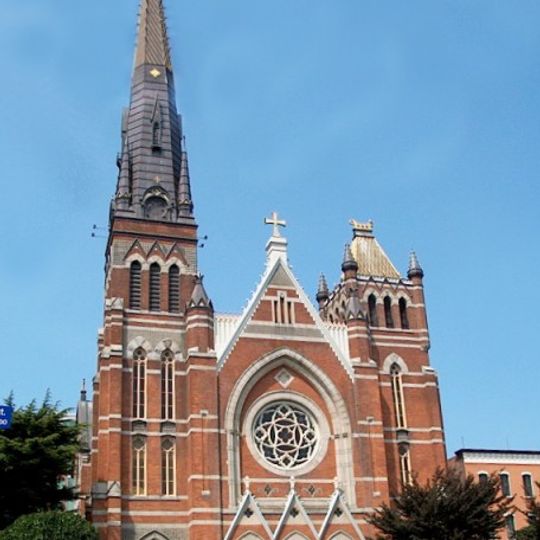
St. Andrew's Cathedral, Roman Catholic cathedral in Victoria, Canada
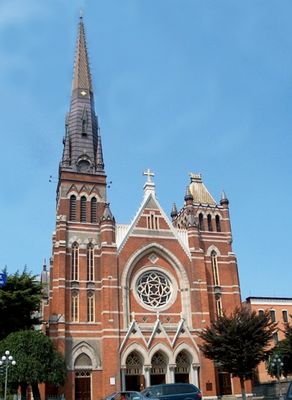
St. Andrew's Cathedral is a Roman Catholic cathedral in Victoria, British Columbia, built in the High Victorian Gothic style. Its two asymmetrical towers follow the pattern of Quebec churches, and the main tower carries a 53.4 m (175 ft) spire designed to hold a clock and bells. The 22-metre nave has a rose window, and the interior holds 21 large Portland-style stained glass windows and two large rose windows.
Work on the present cathedral began in 1890, and on October 30, 1892, Bishop Jean-Nicolas Lemmens blessed it before celebrating a Pontifical High Mass. It is the third church used by the parish: the first served from 1858 to 1884, the second from 1884 to 1892. Architects Maurice Perrault and Albert Mesnard based the design on plans for a church in Vaudreuil-Dorion, Quebec. The building cost C$81,052 and has been a National Historic Site of Canada since 1990.
The interior displays artworks from Northwest Coast Indigenous peoples, including a carved lectern by artist Roy Henry Vickers and bentwood boxes with seasonal patterns used during church celebrations. These pieces are visible from the entrance and shape the character of the whole interior.
The cathedral is open to visitors and can be explored at your own pace, so it is worth setting aside enough time to take in the stained glass and the Indigenous artworks. Be aware that access for general visitors may be limited during services.
The crypt holds three former Bishops of Victoria: Modeste Demers, the diocese's first bishop; Charles-Jean Seghers, the second; and John Jonckau, a vicar general appointed bishop who died before his consecration. The crypt is easy to miss from the nave above.
The community of curious travelers
AroundUs brings together thousands of curated places, local tips, and hidden gems, enriched daily by 93,773 contributors worldwide.