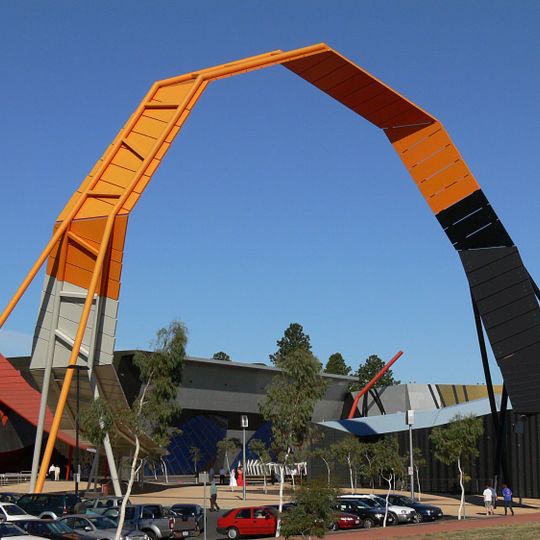
National Museum of Australia, National museum on Lake Burley Griffin shore, Canberra, Australia.
The National Museum of Australia stands on Acton Peninsula beside Lake Burley Griffin in Canberra. Howard Raggatt's 2001 building is a non-symmetrical complex of coloured volumes wrapped in anodised aluminium panels, some carrying words in braille. A bright orange loop sculpture, the Uluru line, unrolls from the entrance along the peninsula, and the Garden of Australian Dreams fills the centre.
The museum came into being through an act of parliament in 1980, but spent two decades without a permanent home. The current building opened in March 2001 on Acton Peninsula and brought the collections to a lasting location.
The museum's five permanent galleries include Gallery of the First Australians and Eternity: Stories From the Emotional Heart of Australia. The National Historical Collection holds over 210,000 objects, among them the world's largest collection of Aboriginal bark paintings and stone tools. The museum also serves as a temporary repository for ancestral remains being repatriated to Indigenous communities.
The building stands on Acton Peninsula beside the Australian National University, reached by a walkway that continues from the orange loop sculpture at the entrance. The Uluru line runs from the forecourt along the peninsula, so the approach itself shows how the site was tied into Walter Burley Griffin's city plan. Exhibition space covers 6,600 m², and the Garden of Australian Dreams sits at the centre of the complex.
The architecture of the building takes its form from knotted ropes, a reference to interwoven narratives of the past. This design runs through the facade and floor plan and recalls the connection between stories and people.
The community of curious travelers
AroundUs brings together thousands of curated places, local tips, and hidden gems, enriched daily by 94,243 contributors worldwide.


