Dilmun Burial Mounds, Necropolis in northern Bahrain
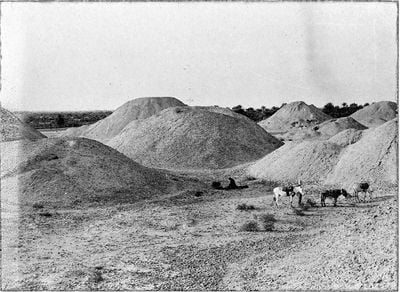
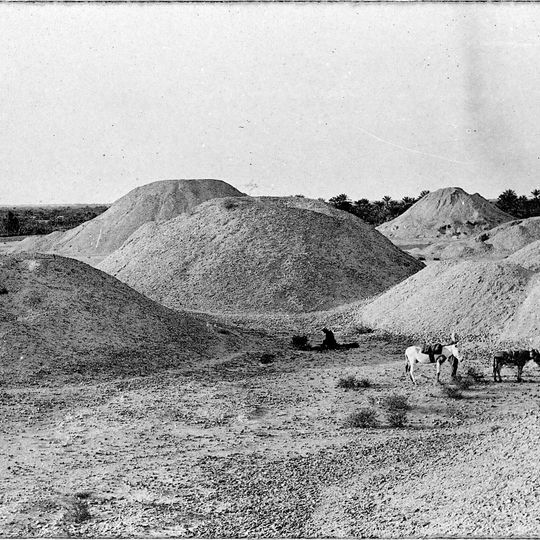
The Dilmun Burial Mounds are necropolis fields of low stone chambers enclosed by ring-walls and covered with earth and gravel, concentrated on the hard stony ground of northern Bahrain's main island. Most mounds measure about 4.5 by 9 m across and stand 1 to 2 m high; the chambers are usually rectangular with one or two alcoves at the northeast end.
The mounds were excavated in February 1889 by the British explorer J. Theodore Bent and his wife Mabel Bent, who found pieces of ivory, charcoal and ostrich eggshell, now in the British Museum. At A'ali, Mound 8 held three cuneiform inscriptions naming Yaglī-'el, son of Ri'mum, servant of Inzak of Akarum. In the 1950s a Danish team working at Qal'at al-Bahrain opened tumuli with items of the same culture. UNESCO listed the site in 2019.
Local people know the site as the A'ali cemetery. In 1889 the British explorer J. Theodore Bent and his wife Mabel excavated some mounds and found pieces of ivory, charcoal and ostrich eggshell, now in the British Museum. At A'ali, Mound 8 held three cuneiform inscriptions naming Yagli-'el, son of Ri'mum, servant of Inzak of Akarum.
The mounds lie in the north of Bahrain's main island, on hard stony ground slightly above the farmed soils, in fields such as A'ali East and West, Janabiya and Hamad Town. The A'ali fields are the easiest to reach from Manama. There are no marked paths or information boards; the mounds stand in open ground, so wear sturdy shoes and carry water.
The mounds lie in Bahrain's north, not the west, on stony ground above farmland. At A'ali, Mound 8 held three cuneiform inscriptions naming Yaglī-'el, son of Ri'mum, servant of Inzak of Akarum; the same text was found at Qal'at al-Bahrain.
The community of curious travelers
AroundUs brings together thousands of curated places, local tips, and hidden gems, enriched daily by 92,870 contributors worldwide.