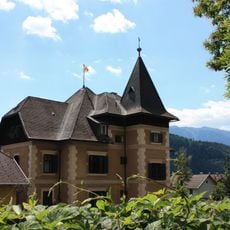
Millstätter See, Lake in Carinthia, Austria
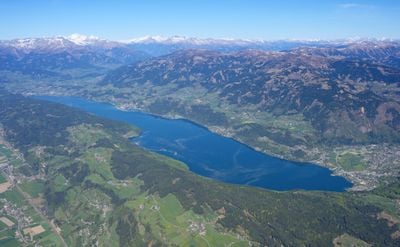
Millstätter See is a lake in Carinthia, Austria, lying at 588 m above the Adriatic north of the Drava Valley near Spittal an der Drau. It runs about 11.5 km east to west and is up to 1.8 km wide, with a maximum depth of 141 m. Its steep shore gives it a fjord-like character, and the wooded Seerücken ridge separates it from the Drava Valley to the south.
The lake formed during the Würm glacial period about 20,000 years ago, when a northern branch of the Drava glacier melted in place, leaving dead ice and fluvial deposits that dammed meltwater at the western rim. Downcutting by the outflow into the Lieser River then lowered the water level. The lake is a remnant of the last ice age.
The lake takes its name from the market town of Millstatt on the northern shore, not from the abbey. A widespread legend instead traces the name to the Latin mille statuae, a thousand statues that the Carantanian duke Domitian is said to have had thrown into the water after his conversion to Christianity. Linguists derive the place name from Milsstatt, a settlement on the Mils brook, whose name goes back to a pre-Slavic word for a mountain stream.
The B98 Millstätter Straße runs along the northern shore, where Seeboden, Millstatt and Döbriach are the main settlements; the southern shore is a protected area and almost uninhabited. The Spittal-Millstättersee station on the Tauern Railway and the A10 junction at Spittal connect the lake. Since 1901 a shipping company has run summer boats on the water.
The lake's basin holds 1,204.5 million cubic metres of water, more than any other lake in Carinthia, although Lake Wörth has the larger surface. Its maximum depth of 141 metres is also the greatest in the state. The water is meromictic and reaches drinking-water quality.
The community of curious travelers
AroundUs brings together thousands of curated places, local tips, and hidden gems, enriched daily by 92,641 contributors worldwide.