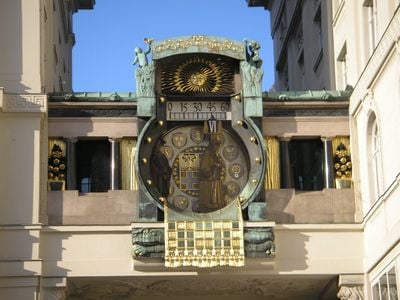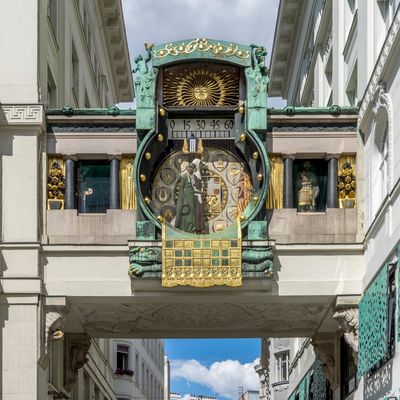
Ankeruhr, Art Nouveau clock in Hoher Markt, Austria
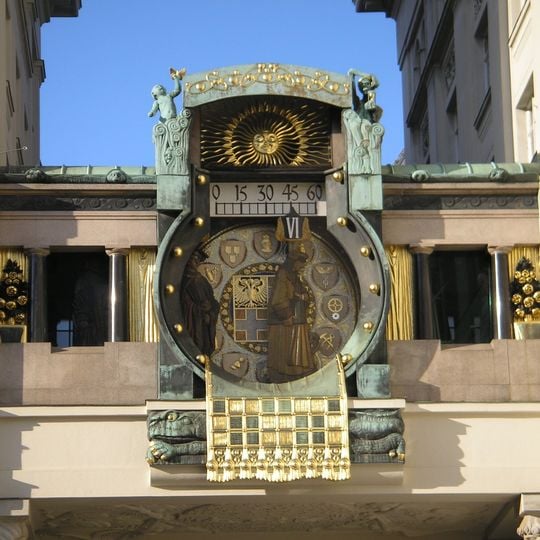
The Ankeruhr is an Art Nouveau clock on Hoher Markt that spans about 10 meters wide. Its face, roughly 4 meters in diameter, displays twelve historical figures that move throughout the day.
The Anker Insurance Company planned a large public clock at its new Ankerhof headquarters in 1911; Franz Matsch designed it and Franz Morawetz built the movement. World War I delayed completion, and the first test run took place on 18 August 1915, the emperor's birthday. After 1918 the imperial anthem was replaced by a piece from Haydn's oratorio The Creation. Arson damaged the clock on 11 April 1945, and it ran again only in 1956.
The twelve copper figures, chosen by Franz Matsch, appear in historical order, from Marcus Aurelius to Joseph Haydn. Each hour one glides along a chain drive past the scale; at noon all twelve parade to matching music. The noon music was originally played on an 800-pipe mechanical organ, now a digital recording.
The clock hangs over the narrow Bauernmarkt passage, so the figures are best seen from the square in front; at noon all twelve pass by with music. The figures slide along a scale rather than rotating, and the hour appears as a Roman numeral above them. At night spotlights light the bridge.
The figure at noon's final position is not Emperor Franz Joseph I but Joseph Haydn, composer of the imperial anthem it once accompanied. After 1918 the anthem was replaced with a piece from Haydn's oratorio The Creation. The twelve melodies heard today were recorded in 1978 in a Viennese church, based on the original organ settings.
The community of curious travelers
AroundUs brings together thousands of curated places, local tips, and hidden gems, enriched daily by 94,059 contributors worldwide.