Plansee, Lake in Reutte District, Tyrol, Austria
Plansee is a lake in Reutte District, Tyrol, Austria, in the Ammergau Alps. It has two basins 77 and 72 m deep over 2.87 km², making it the largest lake in the Außerfern and Tyrol's second-largest natural lake after Achensee. Its long, irregular teal-green surface narrows into a slender arm at the near end and widens into a broader basin farther back, with an uneven shoreline of small inlets and pale sediment edges.
Plansee is first recorded as Planse in a border description of the Diocese of Freising from 1073/78; early forms include Please, Plense and Plase, from Middle High German Plan- for "plain", Latin planus. Fishing rights passed to Stift Stams in the 15th century, and Emperor Maximilian I's fishing book of 1500 names the Plansee among the sovereign's key waters. A 1631 contract under Archduke Leopold V confirmed Stams' limited rights.
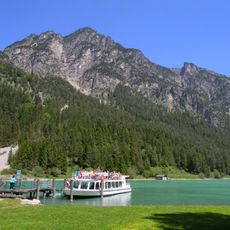
The name Plansee derives from the Middle High German Plan, meaning "plain", from Latin planus. In Maximilian I's fishing book of 1500 the lake is listed among the most important waters for the sovereign's hunting and fishing. A commercial boat line, among Austria's highest, runs round trips calling at the hotels Forelle, Seespitze and Fischer am See.
The Planseestraße (L 255) runs along the northern shore between Reutte and Ettal. Boats of the lake's commercial line call at the hotels Forelle, Seespitze and Fischer am See from late May into autumn. At the north end, in the hamlet Am Plansee, there is a campsite, an alpine dairy with a show cheese-making room, and a scheduled boat stop. In winter the water level is drawn down by up to 5 m for the power station.
A canal about 300 meters long connects this lake to the nearby Heiterwang lake at higher elevation. This man-made link creates a rare network of connected waters that opens up unusual opportunities for boating and water activities.
The community of curious travelers
AroundUs brings together thousands of curated places, local tips, and hidden gems, enriched daily by 92,596 contributors worldwide.