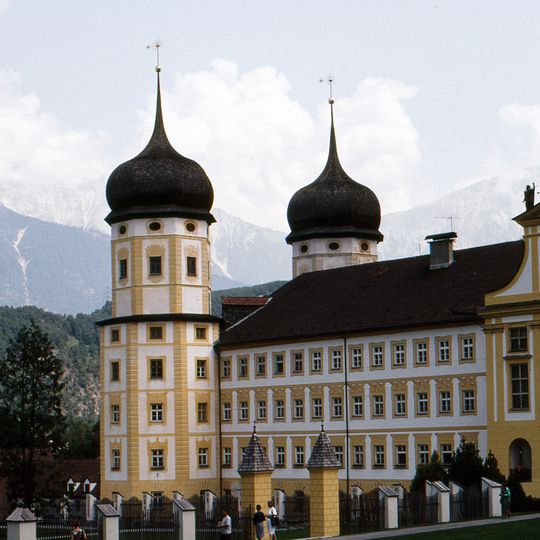
Stams abbey, Cistercian monastery in Stams, Austria
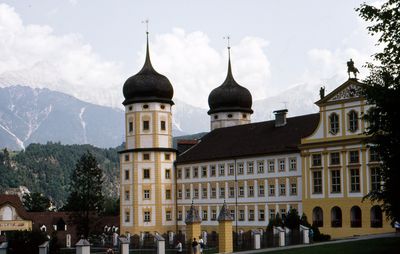
Stams Abbey is a Cistercian monastery featuring distinctive Baroque architecture set in the Tyrolean landscape. The complex displays an organized layout with a church, cloister, residential buildings, and art collections, all integrated into a coherent composition.
The monastery was founded in 1273 when the Prince of Görz-Tyrol brought monks from Kaisheim in Swabia to establish the community. Over the centuries, the abbey underwent transformations, especially during the Baroque period when its current appearance took shape.
The Bernhardisaal, a two-level hall in the abbey's west wing, was built around 1720 by Georg Anton Gumpp. Its ceiling and walls carry frescoes painted in 1722 by Franz Michael Hueber and his pupil Anton Zoller showing scenes from the life of Saint Bernard of Clairvaux. The ceiling opens through a carved and gilded wooden gallery.
Visitors can join guided tours through the church, royal crypt, and museum sections. The visits are offered with detailed explanations of the architecture and art collections, helping guests understand the spaces and their significance more fully.
The Heilig-Blut-Kapelle, rebuilt by Georg Anton Gumpp in 1715-17, is closed by a wrought-iron grille called the Rosengitter, forged over six years up to 1716 by locksmiths from Silz with 80 differently shaped roses. Inside, the altar is by Sigmund Zeller with statues by Andreas Kölle, and the wall paintings are by Josef Schöpf.
The community of curious travelers
AroundUs brings together thousands of curated places, local tips, and hidden gems, enriched daily by 92,867 contributors worldwide.