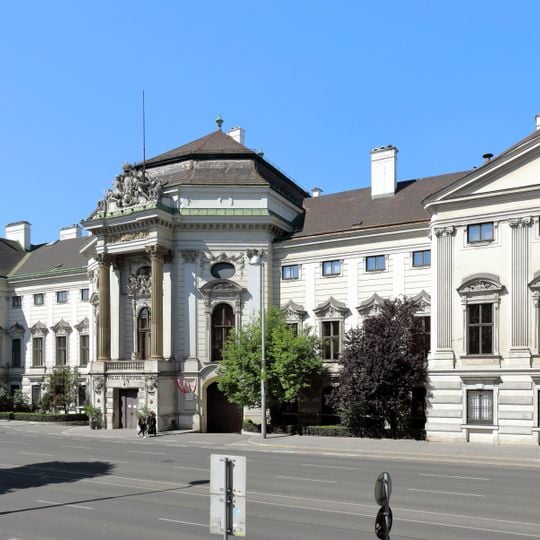
Palais Auersperg, Baroque palace in Josefstadt, Austria
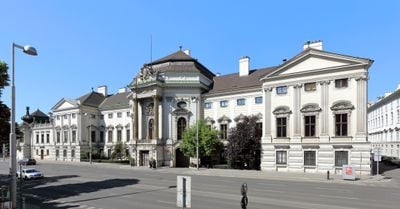
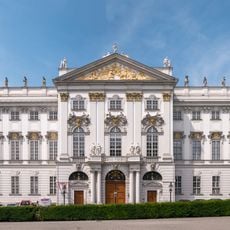
Palais Auersperg is a Baroque city palace in Vienna's Josefstadt district with elaborate interior decoration. The rooms feature marble finishes, crystal chandeliers, and an oval-shaped hall that spans multiple floors, known as the Rosenkavalier Room.
Built between 1706 and 1710 for Hieronymus Capece de Rofrano to plans by Johann Bernhard Fischer von Erlach and Johann Lukas von Hildebrandt, the palace's central section was altered in 1720–1723 by Johann Christian Neupauer. Prince Johann Adam of Auersperg bought it in 1777 and gave it his name; from 1786 Mozart's Idomeneo and Haydn's Sieben Worte were performed here.
The palace's name comes from Prince Johann Adam of Auersperg, who bought it in 1777; in the 20th century it was briefly called Palais Rosenkavalier after the opera, whose character Octavian Rofrano echoes the original owner's name. From 1786 Mozart's Idomeneo and Haydn's Sieben Worte des Erlösers am Kreuze were performed here, and in 1878 Wilhelmine Kinsky staged charity theatre and concerts in the Rosenkavaliersaal with aristocrats taking part.
The building sits on Lerchenfelderstrasse and is well connected by public transport, including the Rathaus subway station and tram line 46 nearby. Parking spaces are limited, especially on weekdays.
A plaque beside the main entrance recalls that Christiane Croÿ and her family lived in the upper rooms during the war and hid resistance fighters there. In 1944 the Provisional Austrian National Committee, known as O5, was founded in the palace; in 1945 the Allied military police seized the building as headquarters.
The community of curious travelers
AroundUs brings together thousands of curated places, local tips, and hidden gems, enriched daily by 94,131 contributors worldwide.