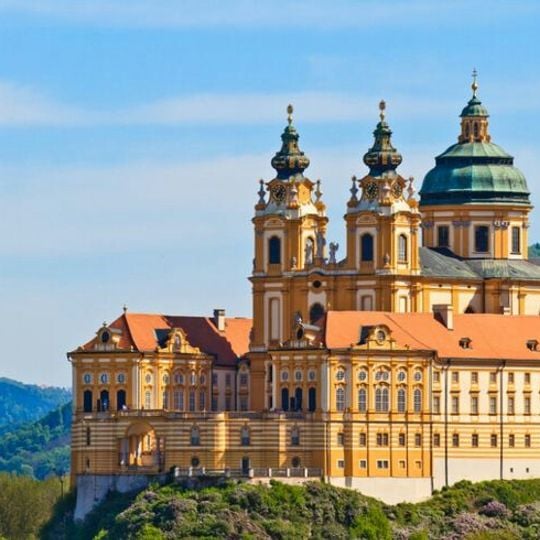
Melk Abbey, Benedictine monastery and museum in Melk, Austria.
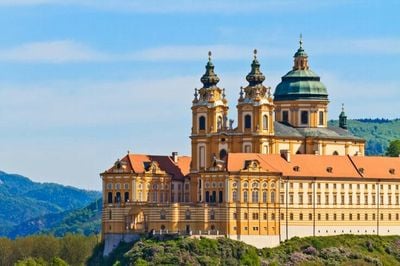
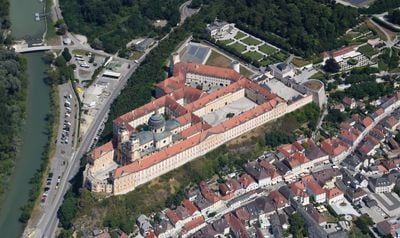
Melk Abbey stands on a rocky outcrop above the town of Melk on the right bank of the Danube, overlooking the river and the Wachau valley. The pale yellow baroque building, designed by Jakob Prandtauer and built from 1702, rises in tiers: two symmetrical towers with dark bulbous cupolas and clock faces flank a central facade with arched windows, statues and a cross. A curved balustraded terrace runs across the front, and the lower walls are banded in yellow and white. Connected wings with red tiled roofs enclose a large inner courtyard and a smaller one behind.
Margrave Leopold II founded the monastery in 1089 and handed it over to the Benedictines for administration. The current building arose between 1702 and 1736 following plans by Jakob Prandtauer after a fire destroyed the medieval predecessor.
The abbey holds the tomb of Saint Coloman of Stockerau and the remains of several Babenbergs, Austria's first ruling dynasty. Its church is dedicated to Saints Peter and Paul, though Coloman is the monastery's patron. Since 1625 it has belonged to the Austrian Congregation of the Benedictine Confederation.
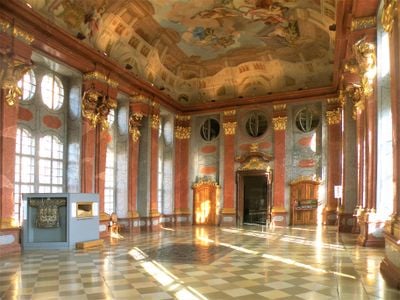
The rooms are open from April to October and the route leads through the Imperial Staircase to the Marble Hall, then to the library and finally into the church. The site sits on a hill, so comfortable shoes are recommended for stairs and slopes.
In 2008 National Geographic Traveler awarded the monastery the title of best historical destination worldwide. The jury recognized the care for the building and responsible tourism at the site.
The community of curious travelers
AroundUs brings together thousands of curated places, local tips, and hidden gems, enriched daily by 92,725 contributors worldwide.