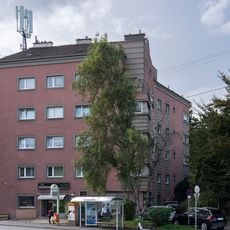
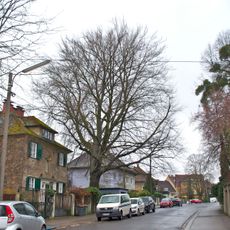
Bergschlößl, Baroque mansion in the Volksgartenviertel, Linz, Austria
The Bergschlössl is a Baroque building in the Volksgartenviertel of Linz, erected in 1717–1718 by master builder Johann Michael Prunner. It has three storeys and nine rooms. Inside, 18th-century wall paintings in the Sala Terrena, the Oktagon room and the Pompeian bath on the first floor survive; the Sala Terrena murals take the former castle park as their model.
Johann Michael Prunner built the Bergschlössl in 1717/18 for the estates' syndic Johann Jakob Mäderer von Ehrenreichscron, on land Linz had bought in 1708 for clay extraction and a brick barn. In 1777 it passed to the Jesuit college Nordico, which laid out a botanical garden; after Joseph II dissolved the order in 1787 a farmer bought it, cleared part of the garden and sold plots. Owners then changed repeatedly until industrialist Robert Weingärtner bought it in 1902.
The name refers to the elevated site in the Volksgartenviertel, not to Froschberg. The park was laid out around 1777 as a botanical teaching path for the Jesuit Nordico college under naturalist Johann Ignaz Schiffermüller. Stone figures of Ceres, Flora with a flower garland and Pan with panpipes decorate the garden, alongside old rarities such as an American tulip tree and Asian yews.
The manor house is located at Bergschlösslgasse 1 in central Linz and now serves as an event venue and educational facility. Visitors should note that access and opening hours vary depending on usage, and checking in advance is recommended.
Between 1992 and 1998, architect Peter Riepl carried out a thorough renovation of the building while preserving its historical elements. This careful restoration allowed the property to function as a modern event and training facility without losing its historical character.
The community of curious travelers
AroundUs brings together thousands of curated places, local tips, and hidden gems, enriched daily by 94,517 contributors worldwide.