Czartoryski-Schlössel, Palace in Währing district, Vienna, Austria
Czartoryski-Schlössel is a three-story palace featuring Empire-style architecture arranged in a horseshoe configuration, with a central section and two side wings along Währinger Straße. The rooms combine classical proportions with elaborate interior appointments.
A villa built in 1748 for court jeweller Josef Friedrich Schwab stood on the site; banker Jakob Friedrich van der Nüll acquired it in 1807 and had it rebuilt in the Empire style to house his collections. Sir Henry Wellesley, British ambassador and brother of the Duke of Wellington, bought house and garden in 1826 for 28,400 Gulden and enlarged the palace. Prince Konstantin Adam Czartoryski acquired it in 1832/1834 and opened his paintings and miniatures to the public. The city of Vienna bought the estate in 1912, and the building was demolished in 1957.
Prince Konstantin Adam Czartoryski opened his picture and miniature collection to the public and hosted concerts in the palace, where Hector Berlioz and Franz Liszt performed. A private theatre staged German and French classics in the original language. The building was called "Czartoryski-Schlössel" by the Viennese.
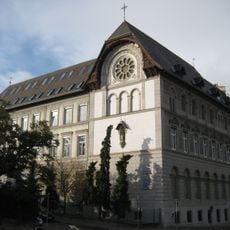
The palace no longer exists: it was demolished in 1957, and a school for physically disabled children, named after Hans Radl in 1989, was built on the site by 1959. The address is Währinger Straße 175–181 in Währing, reachable by tram along Währinger Straße. Look for the school building, not a palace.
Before the building changed hands, valuable inlaid doors and wooden floors were removed and transported to Galicia, where they were destroyed during World War I. This loss reveals how artworks from the region were lost to the ravages of war.
The community of curious travelers
AroundUs brings together thousands of curated places, local tips, and hidden gems, enriched daily by 94,058 contributors worldwide.