Riegersburg Castle, Medieval fortress in Riegersburg, Austria.
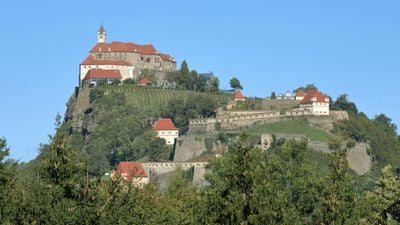
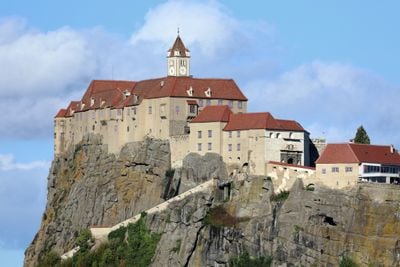
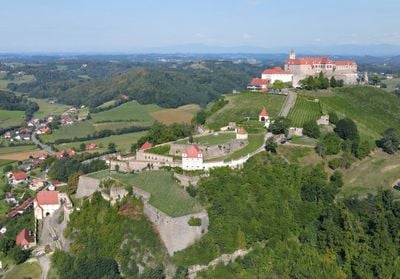
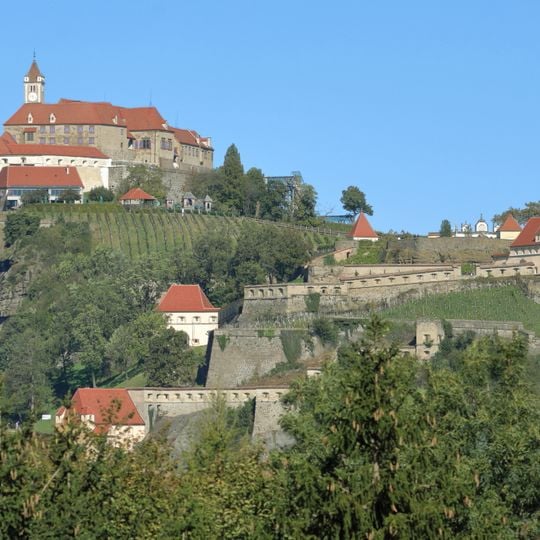
Riegersburg Castle is a medieval fortress on a steep basalt hill above the town of Riegersburg in southeastern Styria. Pale stone walls with white plastered sections and red tiled roofs step down the slope, and a square white clock tower with a red pyramidal roof rises from the center. Vineyards cover the hillside between the defensive walls, which run for three kilometres and enclose 108 rooms.
The castle first appears in documents in 1138 as "Ruotkerspurch", named for a Rüdiger, though the basalt cone was settled around 6000 years ago. Around 1100 the upper fortress rose on the north summit; the Walseer family acquired the whole lordship by 1320. Erasmus von Stadl rebuilt the high castle in late Renaissance style from 1571, and between 1637 and 1653 Elisabeth Katharina von Galler completed it as one of the country's strongest castles.
Of the 108 rooms, 25 are open to visitors: sixteen trace the castle's history and nine are devoted to witches and sorcerers. The witch rooms recall the Feldbach trials of 1673–1675, in which Katharina Paldauf was one of the best-known victims. Ten hectares of vineyards inside the walls have been leased to the Bernhart winery of Riegersburg since the time of Lady Galler.
A steep inclined elevator on the north side shortens the climb; the on-foot ascent from the village is steeper and hot in summer. A barrier-free hiking trail runs between the lift and the village ascent. Of the 108 rooms, 25 are open to visitors.
The basalt crag under the castle is the plugged throat of a volcano that erupted more than two million years ago, when water met magma in phreatomagmatic explosions. The rock rises over 100 metres above the surrounding land, and the region takes its name, Styrian Volcanic Land, from such hills.
The community of curious travelers
AroundUs brings together thousands of curated places, local tips, and hidden gems, enriched daily by 92,990 contributors worldwide.