Pfarrkirche Bruck an der Leitha, Catholic parish church in Bruck an der Leitha, Austria
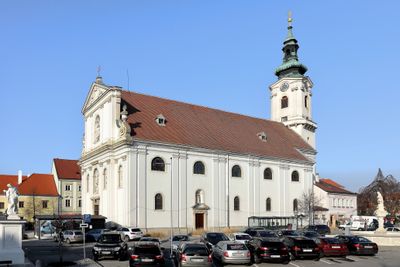
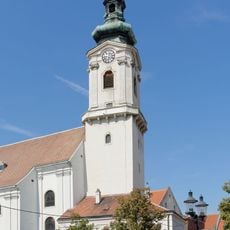
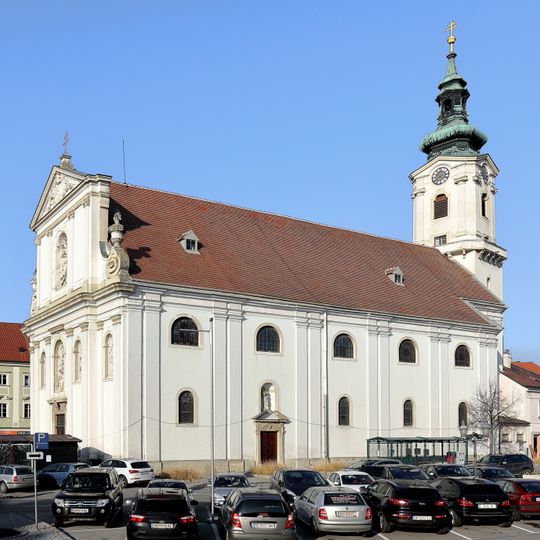
Pfarrkirche Bruck an der Leitha is a baroque church built against the medieval town tower, which stands twisted about 15 degrees north because the nave runs parallel to the house fronts. Its two-storey facade by Johann Georg Windpässinger carries figures of St John of Nepomuk above the main portal, St Michael in the upper storey and the town coat of arms dated 1740. The single-nave interior is 42 metres long and 14 metres wide, with three-metre chapel niches and a four-bay vaulted ceiling.
The old St. Martin's church outside the walls was repeatedly destroyed and had grown too small, so in the mid-17th century the town resolved to build a new parish church inside the gates. Ottoman sieges and plague thwarted the plans until 1683, when the council vowed a worthy church on the Hauptplatz after Vienna's relief. Built 1696–1702 under Heinrich Hoffmann against the medieval town tower, which stands twisted about 15 degrees north, it was modelled on Il Gesù in Rome. Johann Georg Windpässinger added the two-storey facade in 1738–40; the spire reached 53.35 m in 1782–83.
The high altar, donated in 1704 by Johann Jakob Stumpf, physician to Emperor Leopold I, holds an altarpiece of the Holy Trinity from the circle of Daniel Gran. The church also keeps a baroque glass sarcophagus with the bones of the martyr Saint Theodorus, and the facade shows Saint John of Nepomuk above the main portal with the Moldau bridge at his feet.
The nave runs parallel to the house front, so the medieval city tower serving as the bell tower stands twisted about 15 degrees to the north. The entrance front on the Hauptplatz carries the town coat of arms with the year 1740 above the main portal. The interior is 42 metres long and 14 metres wide, with chapel niches three metres deep on both sides.
The organ, built in 1710 by Viennese organ maker Jakob Sippus, is crowned by a statuette of King David. Johann Hencke added a five-stop Rückpositiv in 1740, and Alois Hörbiger installed a new console in 1858. Today it holds 300 wooden and 996 tin pipes in 20 stops, all labial, the largest pipe five metres long.
The community of curious travelers
AroundUs brings together thousands of curated places, local tips, and hidden gems, enriched daily by 93,523 contributors worldwide.