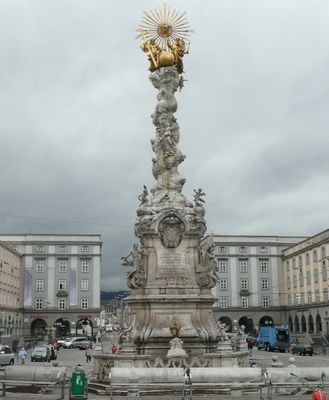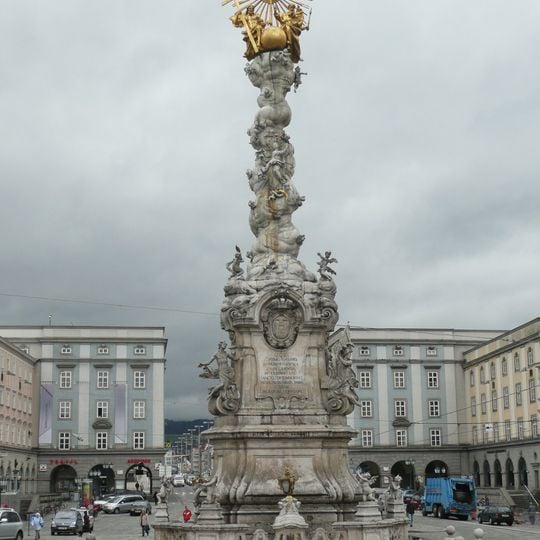
Dreifaltigkeitssäule, Baroque monument in Hauptplatz, Linz, Austria
The Trinity Column is a Baroque monument made of white Untersberger marble that stands in the center of Hauptplatz and rises approximately 20 meters high. The monument features a gilded group of figures at its top with the Immaculate Mary on a crescent moon, decorated below with angels seated on clouds.
The column was commissioned by Emperor Charles VI, the Upper Austrian Estates and the citizens as thanks for Linz being spared the last great plague wave, the Turkish wars of 1683, the Spanish War of Succession in 1704 and a threatened fire in 1712. Salzburg master stonemason Sebastian Stumpfegger built it between 1717 and 1723 to a design by Antonio Beduzzi. Finished in 1723, it was consecrated only on 17 November 1728 by town deacon Max Gandolph Steyrer von Rothenthurn, after an inquiry into its cost of 30,000 guilders. The pillory that had stood on Hauptplatz until 1716 was moved to the Taubenmarkt for its sake.
The column serves as a monument to the city's survival of hardship and displays three coats of arms representing imperial, regional, and local authority on its base. These symbols show how the community understood its place within a larger political order.
The monument sits in the busy center of Hauptplatz and is easy to reach on foot from multiple sides of the square. A complete restoration completed between June 2019 and July 2020 ensured that the stone and gilded elements remain in good condition.
The column was funded by three parties: Emperor Charles VI, the Upper Austrian Estates and the citizens of Linz. Their three coats of arms are set into the base, each facing the building it represents — the imperial stone on the sunny south side, the provincial arms toward the Landhaus, the city arms toward the Old Town Hall.
The community of curious travelers
AroundUs brings together thousands of curated places, local tips, and hidden gems, enriched daily by 92,783 contributors worldwide.