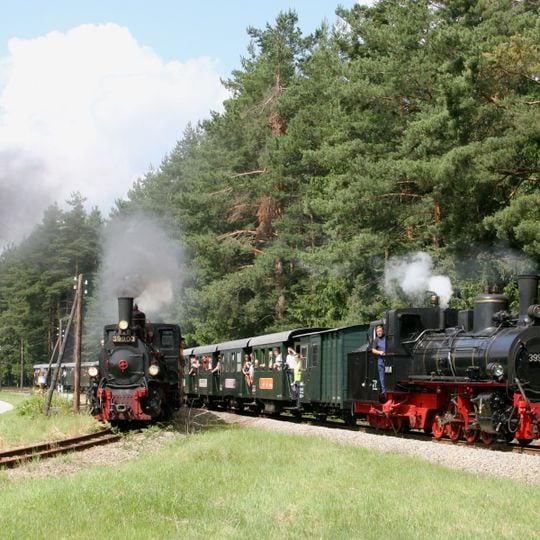
Waldviertel narrow gauge railways, Heritage railway line in Lower Austria, Austria.
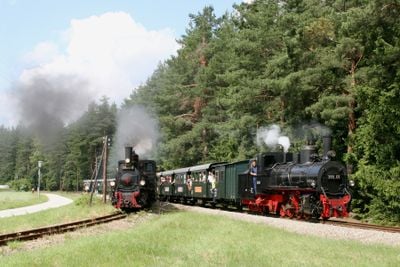
The Waldviertel narrow gauge railways form a 760 mm network of three connected lines radiating from Gmünd in Lower Austria: north to Litschau (25 km), a branch from Alt-Nagelberg to Heidenreichstein (13 km), and south to Groß Gerungs (43 km). The southern line crosses rocky terrain with two tunnels and several bridges and viaducts. Heritage trains pair black steam locomotives such as No. 399 with green carriages, sometimes with a second locomotive at the rear.
The network was created in 1899 with the founding of a dedicated company and began operations in 1900. This early development was part of the region's industrialization and continues to shape its infrastructure today.
The railway connects communities like Gmünd, Litschau, and Heidenreichstein and shows how the region developed during early industrialization. Today trains move through a landscape shaped by forests and lakes that define the Waldviertel area.
The three branches leave from Gmünd station: north to Litschau (25 km) with the 13 km Heidenreichstein branch from Alt-Nagelberg, and south to Groß Gerungs (43 km), the longest, with two tunnels and several bridges. Scheduled daily trains ran only in July and August 2017, mostly diesel railcars of class 5090, with steam locomotives on marked days; check the timetable before travelling.
The network's three branches total 81 kilometres: Gmünd–Litschau 25 km, Alt-Nagelberg–Heidenreichstein 13 km and Gmünd–Groß Gerungs 43 km. The southern line crosses rocky terrain with two tunnels and several bridges and viaducts. A 12 km link to Nová Bystřice, on the same 760 mm gauge, was planned but never built.
The community of curious travelers
AroundUs brings together thousands of curated places, local tips, and hidden gems, enriched daily by 93,681 contributors worldwide.