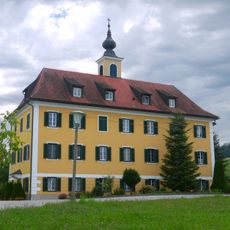
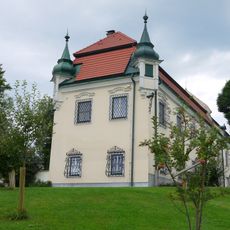
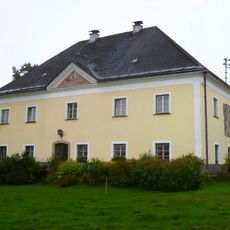
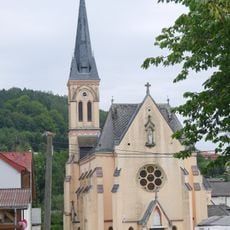
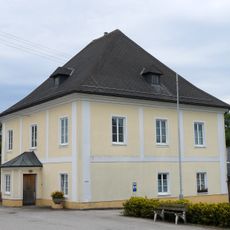
Schloss Wolfsegg, Renaissance château in Wolfsegg am Hausruck, Austria.
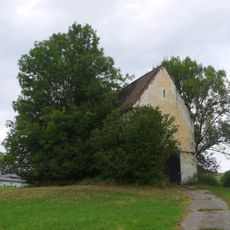
Schloss Wolfsegg stands on a hill above the market town of Wolfsegg am Hausruck. The present building is a 16th/17th-century successor to an earlier castle, whose remains are still visible; the date MDXCIX above the entrance probably marks the conversion from castle to palace. The three-storey main tract is an irregular quadrilateral containing remnants of the old castle wall, and two two-storey corridor wings link it to a parallel three-storey wing, all enclosing an inner courtyard. Opposite the palace stands a horseshoe-shaped farmyard.
Wolfsegg was first called Hausruck, after the Hausrucker family documented with Hadmar I in 1120; the Wolfsecker line followed, and Chunradus de Wolvesekke appears in 1191. After Christian von Wolfsegg died in 1321 the estate was split and disputed, passing to the Habsburgs by 1369. In 1626 General von Pappenheim stormed the castle held by peasants, and it was again stormed and damaged in the 1632 Upper Austrian peasant revolts. Franz von Saint Julien bought the lordship in 1835; his family still owns it.
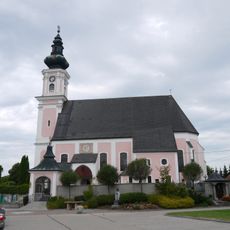
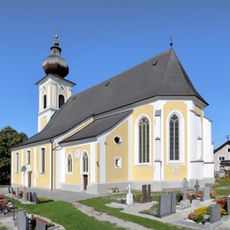
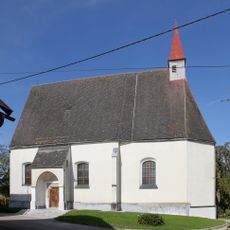
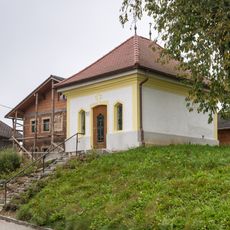
The chapel here dates to 1746 and honors Saint Anna with barrel vaults and ornate stucco decorations inside. An altar painting by Bartolomeo Altomonte adds to the space's character.
Schloss Wolfsegg stands on a hill above the market town of Wolfsegg am Hausruck, so the approach from the centre climbs. Two deep former moats once cut the castle off from the ground in front; only broad hollows remain, and the entrance carries the year MDXCIX above it.
Thomas Bernhard first mentioned Wolfsegg in 1953 as a journalist for the Demokratisches Volksblatt, drawn to the etymology of the name. In his novel 'Frost' he placed a war crime there without naming the location, and his screenplay 'Der Italiener' was filmed on site using specific details of the Wolfsegg topography.
The community of curious travelers
AroundUs brings together thousands of curated places, local tips, and hidden gems, enriched daily by 92,603 contributors worldwide.