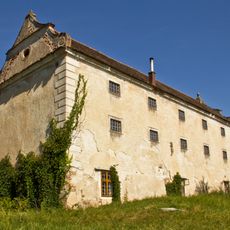
Burg Karlstein, Medieval castle in Karlstein an der Thaya, Austria.
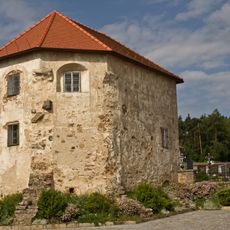
Burg Karlstein is a Gothic castle that rises high on a rocky cliff above the Thaya river, displaying architectural elements from the 14th and 15th centuries. The structure consists of several sections hugging the slope and dominating the river valley below.
Karlstein was first mentioned as Chadelstain in 1112 and belonged as a fief to the respective sovereign. Under the Puchheim family it briefly became a centre of the Reformation from 1576. Because no family held it continuously, it was constantly rebuilt; almost nothing of the original castle survives, and the chapel dates from the 16th century. From 1880 it also housed a clock factory, and it served at times as a prison.
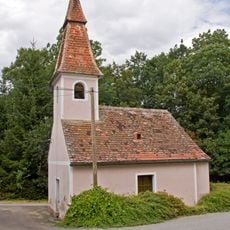
The name Karlstein derives from the medieval form Chadelstain, recorded in 1112. Under the Puchheim family the castle became a centre of the Reformation from 1576, and the surviving chapel dates from the 16th century. Visitors can also note its later roles: a clock factory from 1880, a prison, and after 1919 the holding place of Béla Kun and some 40 members of the Hungarian Soviet Republic.
The castle is in private ownership and visits must be arranged in advance through local tourism offices. It is worth contacting the tourism information in town to inquire about possible tours or access.
From 1880 the castle housed a clock factory, not an 18th-century watch workshop. Its rooms later served as a youth hostel and, in the 1960s, as a guesthouse. In 1914, though the building was uninhabitable, an internment camp was set up here and the Montenegrin General Staff was held. Around 40 figures of the Hungarian Soviet Republic, among them Béla Kun and Jenő Landler, were later gathered at the castle.
The community of curious travelers
AroundUs brings together thousands of curated places, local tips, and hidden gems, enriched daily by 92,645 contributors worldwide.