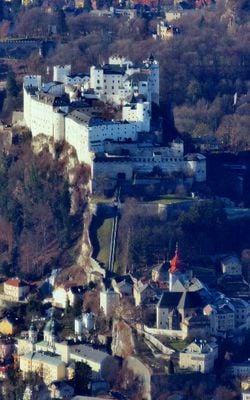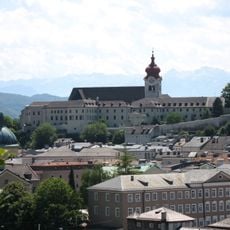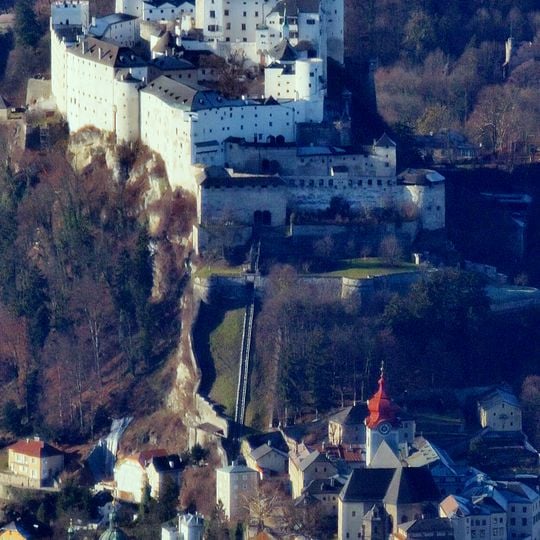
Reisszug, Freight funicular at Hohensalzburg Castle in Salzburg, Austria
The Reisszug is a private goods cable railway running from the grounds of Nonnberg Abbey up to the inner courtyard of Hohensalzburg Castle. Its track is 190 m long and climbs 80 m at a gradient of 65–67%, passing through five concentric defensive walls, each pierced by a gateway that can be closed with a wooden door. The line uses steel rails and a steel cable, with a single car carrying up to 1,500 kg or three persons.
Building-historical findings in the Schlangengang area date the line to at least 1460, in the unsettled years before Bernhard von Rohr's rule; the claim that Leonhard von Keutschach built it in 1502 is now largely refuted. A protective wall was erected around 1461 under Burkhard von Weißpriach, and Matthäus Cardinal Lang described the line in detail in 1515. The present Reisszug building dates from 1644.
The name Reisszug derives from Middle High German rīsen, meaning to move up or down, and zug, from ziehen, to pull: a device for hauling goods. It has nothing to do with a railway train or with tearing. The line is private and not open to the public; the Festungsbahn funicular carries visitors instead.
The line is not open to the public: it carries goods to the fortress, and only authorised people may ride, in exceptional cases. The track runs 190 m with an 80 m height difference at a gradient of 67%, from the Nonnberg Abbey grounds through five walled gateways to the fortress courtyard. The ride takes about 5.45 minutes at 0.55 m/s, and the route is monitored by cameras, so it can also run at night.
The name Reisszug comes from Middle High German rīsen, meaning to move up or down, plus -zug from ziehen, to pull; it has nothing to do with a railway train or with tearing. Until 1910 the line was worked by a horizontal wooden winch turned by horses, and in the 19th century by at least nine convicts.
The community of curious travelers
AroundUs brings together thousands of curated places, local tips, and hidden gems, enriched daily by 93,665 contributors worldwide.