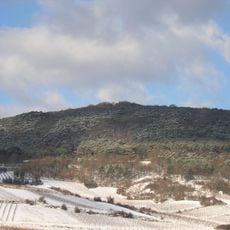
Einödhöhle, Natural monument cave in Pfaffstätten, Austria.
The Einödhöhle lies at 370 m on the south slope of the Pfaffstättner Kogel near Pfaffstätten. It is the largest preserved late Tertiary surf cave on the western edge of the Vienna Basin, cut into dolomite, with two larger and three smaller daylight openings. Two south-facing entrances lead from a levelled forecourt into a first hall 15 m long and 4 m high, with a roughly 50 m partly artificial round passage attached to its north.
The cave system formed roughly 20 million years ago through coastal erosion processes during the Tertiary period. It opened officially to the public on April 22, 1925.
The cave was called "Fledermaushöhle" (Bat Cave) until about 1890; when the older Große Einödhöhle was blown up in 1888, this upper cave took over the name. Legend links the name to the giant warrior "Einöder", said to have fought for Charlemagne in the Avar war. The valley is first mentioned in 1195 in a donation to Heiligenkreuz Abbey.
Since 22 October 1982 the Einödhöhle has been a "particularly protected cave" under Lower Austrian cave protection law, so entering it is forbidden except for scientific purposes. The site is reached on the southern slope of the Pfaffstättner Kogel at 370 m above sea level, north of Baden; the two south-facing entrances open off a levelled forecourt.
This cave represents the largest surviving surf cave from the Tertiary period found along the western edge of the Vienna Basin. Few such formations have been preserved from that ancient coastal environment.
The community of curious travelers
AroundUs brings together thousands of curated places, local tips, and hidden gems, enriched daily by 94,046 contributors worldwide.