Ruine Hohenwang, Castle ruin in Langenwang, Austria
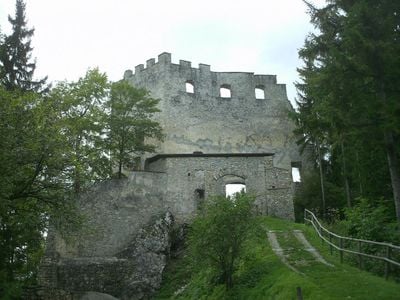
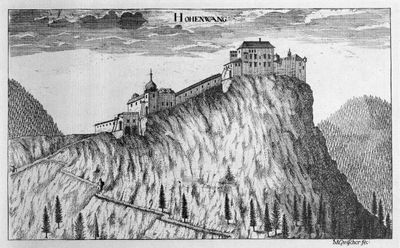
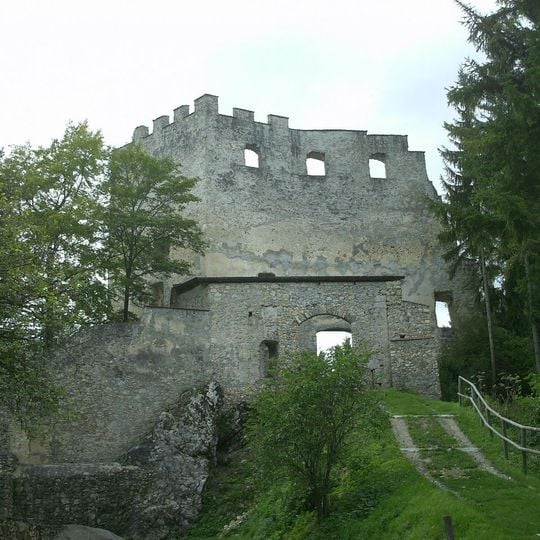
Ruine Hohenwang is an elongated castle ruin oriented from southwest to northeast, about 90 meters long, on a rocky spur at 650 meters above sea level. It consists of a stronghold and two outworks separated by trenches. The preserved shield wall of the high castle and the main gate stand within their perimeter walls. The complex was enlarged from the 13th to the 17th century with a Palas, a gallery, a kennel, a bastion and a representative gatehouse, but has no donjon.
The castle core dates to the 12th century; construction is attributed to Erchinger I. von Landesere and likely took place between 1122 and 1160. It was first documented in 1222. In 1477 King Matthias Corvinus seized it and Hungarian mercenaries held it until the end of the 15th century. An earthquake and stone theft caused severe damage from the late 18th century, and World War II bombing destroyed further parts.
The castle's name passed to the noble family that held it: the Landesere called themselves Lords of Hohenwang from the 12th century. In 1240 the minnesinger Ulrich von Liechtenstein stopped here on his tournament journey and challenged Erchinger II to a joust; they are said to have ridden at each other six times, breaking lances each time without unhorsing the other. He called the castle "hus ze Hohenwang" in his poem Vrowen dienst.
The site is reachable through marked hiking trails and is maintained by the Association Hohenwang Castle. Visitors should wear sturdy footwear and allow time for the uphill walk.
A 15th-century chronicle describes the castle interior: a chapel, a servants' room, a large hall, four cellars, a bath-room, a kitchen and a stable for twelve horses. The three gates, two with slip gates, plus the ditch and steep cliffs to the south, west and north made storming difficult.
The community of curious travelers
AroundUs brings together thousands of curated places, local tips, and hidden gems, enriched daily by 94,051 contributors worldwide.