Wohnhausanlage Friedrich-Engels-Platz, Municipal housing complex in Brigittenau, Austria
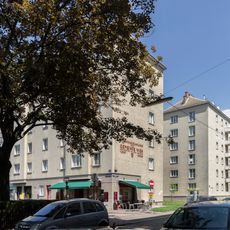
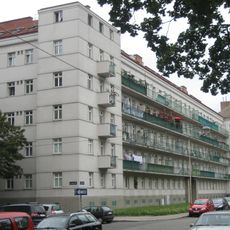
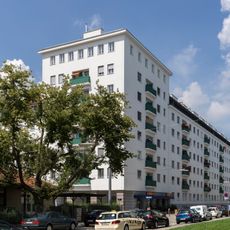
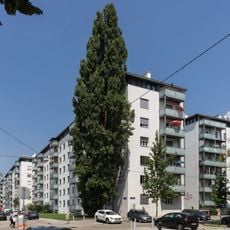
The Wohnhausanlage Friedrich-Engels-Platz is a large municipal housing complex in the Brigittenau district of Vienna, made up of several connected residential blocks with over 1,400 apartments. The buildings are arranged around planted inner courtyards and feature corner towers and decorated balconies.
The complex was built between 1930 and 1933 by architect Rudolf Perco, who had studied under Otto Wagner, as part of Vienna's Red Vienna social housing programme. The goal was to give working-class families access to decent housing within the city.
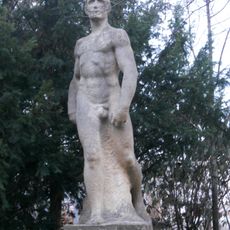
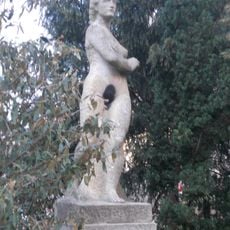
The animal figures and mosaics on the square, showing fish and forest animals, were designed by Mario Petrucci around 1953 and are read as a nod to Brigittenau's former hunting grounds. At the corner of Wehlistraße stands Petrucci's 1952 monument to Gregor Mendel, the discoverer of the laws of inheritance.
The complex is bounded by Friedrich-Engels-Platz to the south, Forsthausgasse, Leystraße, Aignerstraße and Wehlistraße. Friedrich-Engels-Platz and the adjoining Kapaunplatz form an axis splitting it into two courtyards: the western one is fully enclosed, the eastern one opens toward Wehlistraße. Trees planted in the late post-war years screen the front. Several shop premises remain in the complex; the identical buildings at Leystraße 19–21 just north are a separate estate.
The complex was not shelled: on 12 February 1934 police occupied it quickly because leading Schutzbund members had already been arrested and knew the weapons caches. Architect Rudolf Perco's original plan foresaw 2,300 flats and around 10,000 residents, which would have made it the largest housing estate in the world at the time; only 1,467 flats, about two thirds, were built.
The community of curious travelers
AroundUs brings together thousands of curated places, local tips, and hidden gems, enriched daily by 93,899 contributors worldwide.