Schloss Pöllan, Protected heritage castle in Paternion, Austria
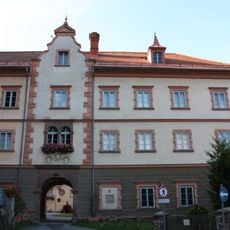
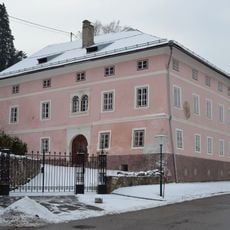
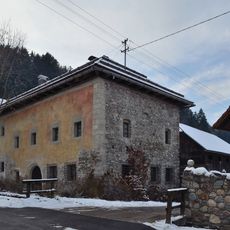
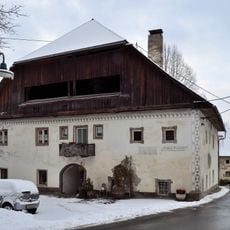
Schloss Pöllan is an unfinished manor house begun around 1600, standing at 629 m south of Paternion. The nearly square, two-storey building with an attic storey has four hexagonal corner towers, only two of which were completed, and an unplastered rubble-stone facade with a round-arched portal of red and brown stone. Scaffold holes remain visible in the walls.
Christoph Haidenreich, administrator of the Paternion estate, began building the castle around 1600 on the site of an earlier 14th-century residence. As a leading Protestant of the Drau valley he defended the Reformation, but pressure from the Catholic clergy forced him to sell the unfinished building and all his lands to the Khevenhüller heirs in 1616. When the Khevenhüllers had to leave Carinthia from 1628, Pöllan passed with the Paternion estate to Hans Widmann in 1629.
The name Pöllan comes from the Slovene Poljána, meaning 'those in the flatland'. The lower entrance hall still shows smoke marks on its vault from use as a smoke kitchen, and a linden tree beside the building is thought to have been planted when it was built around 1600.
The castle is not open to the public and stands on private ground; it is reached from Pöllan, about two kilometres from the Tauernautobahn and three from the Drautal Straße (B 100). The unplastered rubble walls, scaffold holes and the two unfinished hexagonal corner towers can be seen from outside. A linden tree stands close by, probably planted when the building was begun around 1600.
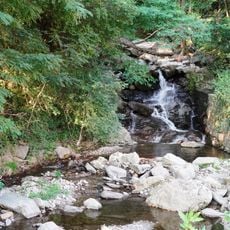
Near the castle at Tragin-Pöllan by the Weißenbach creek, an ancient gold panning site existed where gold in dust and grain form was collected since antiquity. This historical mining shows that the region was valued not only for its fortifications but also for its natural resources.
The community of curious travelers
AroundUs brings together thousands of curated places, local tips, and hidden gems, enriched daily by 92,836 contributors worldwide.