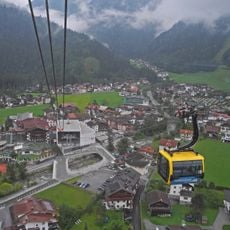
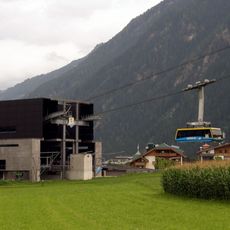
Horbergbahn, Cable car station in Schwendau, Austria
The Horbergbahn is a cable car in Schwendau that links the valley floor to high-altitude ski areas in the surrounding mountains. The system moves people upward using a series of support towers and individual gondola cabins.
The Horbergbahn runs along the route of a 9.2 km material cableway built in 1924–1926 to carry magnesite from the Tux mine to Bühel near Ramsau im Zillertal, where it was loaded onto the Zillertalbahn. That cableway closed when the mine shut in 1976 and was later dismantled. A first Horbergbahn, a four-person single-cable gondola, was built on the line in 1982; the current eight-person version followed in 2000. Foundation remnants of the old material cableway are still visible between its pylons.
The lift is named after the Hoarberg, the slope it climbs toward the Tuxer Alps. Its valley station stands in Schwendau, and the route was laid over the track of a 1924–1926 material cableway that carried magnesite from the Tux mine down to Bühel in Ramsau im Zillertal until the mine closed in 1976. The Mayrhofner Bergbahnen built the lift partly to relieve queues at the Penkenbahn in Mayrhofen.
The Horbergbahn runs only in winter, so hikers cannot use it in summer. From the top station, the Lärchwald Express leads toward the Penken, while the Tappenalmbahn and the 150er Tux connect to the Rastkogel. The Schneekarbahn serves the Hoarberg. The steepest section reaches a 72 percent gradient.
The cable car partly follows a historic route that once transported raw materials from a nearby mine. This transformation shows how old mining paths can find new purpose in modern tourism.
The community of curious travelers
AroundUs brings together thousands of curated places, local tips, and hidden gems, enriched daily by 93,748 contributors worldwide.