Pauliberg, Mountain summit in Markt Sankt Martin, Austria.
Pauliberg is a mountain in Markt Sankt Martin located in Burgenland in eastern Austria. It rises to about 761 meters with steep slopes and rocky outcrops, and today features an active basalt quarry that extracts stone for construction use.
The basalt of Pauliberg is radiometrically dated to about 11 million years ago, in the late Miocene, when crustal stretching beneath the Pannonian Basin fed the eruption. In 1948 the Basaltwerk Pauliberg Gesellschaft mbH was founded with a 50 percent share held by Burgenland, to create jobs and produce gravel and chippings for road building. The quarry was not connected to the power grid in the early 1950s and ran on diesel; a processing plant with automatic loading followed in 1979, and Esterhazy Betriebe GmbH took over the operation in 2009.
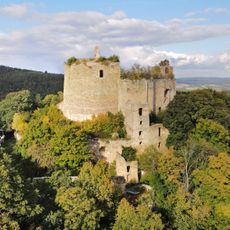
The Hungarian name Pál-hegy is still used for the mountain, a reminder of the region's Hungarian-speaking past. The surrounding Landseer Berge nature park is used for open-air events and educational trails, and the nearby Landsee castle ruin, built in the 12th century, served as an arsenal and refuge during the Turkish wars before falling into decay after 1710.
The summit plateau is reached on foot; the basalt quarry on its northern edge is an active industrial site and not open to visitors. The Pauliberg lies within the Naturpark Landseer Berge, and the surrounding area is served by marked teaching trails (Lehrpfade). The ruins of Landsee castle stand nearby.
Around 60 different minerals had been identified in the quarry at the northern edge of the summit plateau by 2009. A lava tongue on the mountain also holds the Vierlöcherhöhle, the only secondary basalt cave in Burgenland.
The community of curious travelers
AroundUs brings together thousands of curated places, local tips, and hidden gems, enriched daily by 94,043 contributors worldwide.