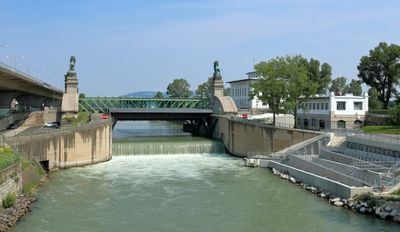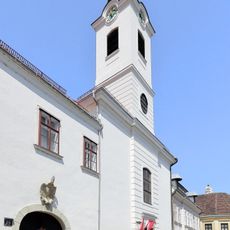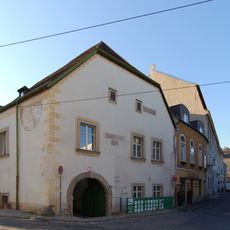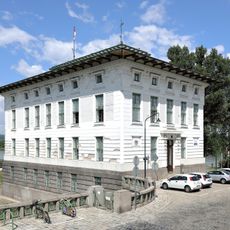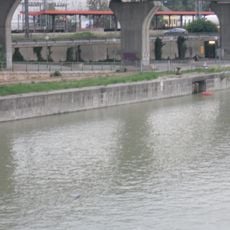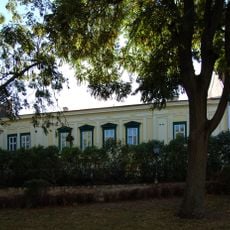
Nußdorf weir and lock, Weir and lock on the Donaukanal in Brigittenau, Vienna, Austria
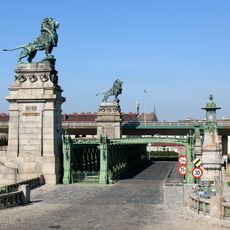
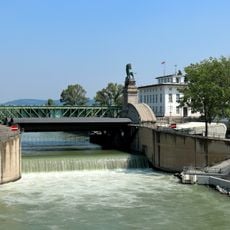
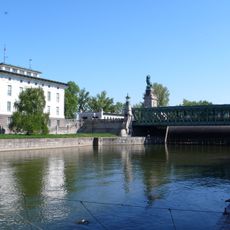
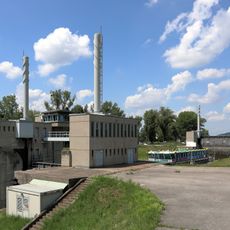
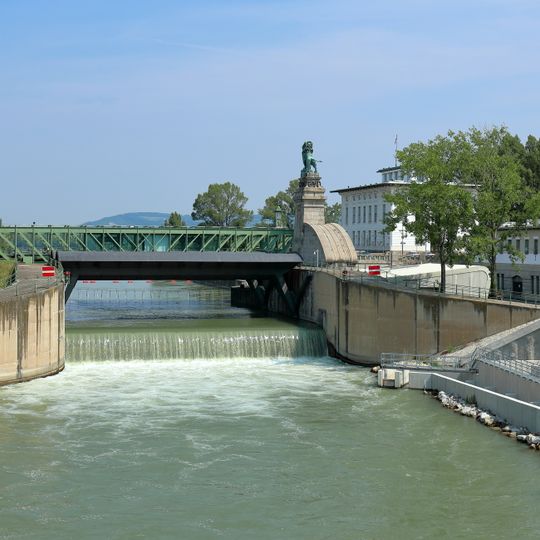
The Nußdorf weir and lock stand where the Donaukanal branches off from the Danube, behind the Nußdorf station of the Franz-Josefs-Bahn. The Schemerlbrücke, a 49-metre truss bridge also called the Löwenbrücke, arches over the 40-metre canal and the 9-metre towpath; its pylons carry bronze lions by Rudolf Weyr. The weir itself is a segment weir with barriers that can be lowered to the canal bed, and the stone structure curves into the arched wall of the weir.
The weir and lock were built under a law of 18 July 1892 that also funded Vienna's Stadtbahn and the canal's conversion into a winter harbour. Work ran from August 1894 to 1899, with masonry finished in 1897 and steel assembly by Albert Milde in August 1898. Otto Wagner designed the architectural form, including the Schemerlbrücke and its bronze lions by Rudolf Weyr; the technical plans came from Siegmund Taussig. The needle weir was replaced by a segment weir between 1971 and 1975.
The bronze lions perched on the columns were part of the original design and remain a striking visual feature. They later inspired the logo of the Gräf & Stift automobile company.
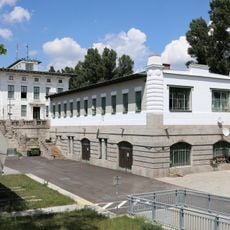
The weir and lock stand behind Nussdorf station on the Franz-Josefs-Bahn, on the Brigittenau side of the canal; the district border runs along the western, Nussdorf bank. The Schemerlbrücke truss bridge carries pedestrians across the canal beside the weir, and the towpath runs beneath its 49-metre span. The structures are viewed from the public paths outside; no visitor platform exists.
The weir's bronze lions by Rudolf Weyr, modelled on Chinese guardian lions, were later used as the logo of the Austrian car maker Gräf & Stift. The Schemerlbrücke, known as the Lion Bridge, was deliberately made unusable in April 1945 and repaired between 1953 and 1955.
The community of curious travelers
AroundUs brings together thousands of curated places, local tips, and hidden gems, enriched daily by 94,119 contributors worldwide.