Seeklause Steeg, Historical water gate in Bad Goisern, Austria.
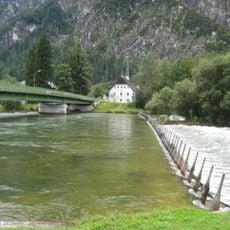
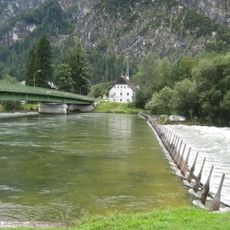
Seeklause Steeg is a water gate in Bad Goisern consisting of twelve stone-filled wooden boxes positioned across the lake outflow. Eleven of these boxes have pivoting gates that control and regulate the water flow downstream.
A first predecessor is often dated to 1511, but primary sources do not confirm this; the weir is documented for 1523. Between 1564 and 1573 Thomas Seeauer, Hallstatt's wood, weir and forest master, raised the structure, giving it essentially its present form. An automatic gate was installed in 2002.
The structure shows how people here have controlled water for centuries to move salt downstream. This technique was fundamental to the region's economic life and trade.
The structure spans the Traun outflow at Steeg, with the main weir and the lower Polster about 40 m downstream; the bridge between them, rebuilt in 1997, crosses the river. The twelve wooden Klausstuben and the eleven pivoting gates are best seen from this bridge and the banks. The lake level can be raised by up to one metre.
A wooden lever called the Torspreize allows a single person to open all gates in a short time, creating a controlled surge of water downstream. This simple but effective hand tool reveals the practical ingenuity of the builders.
The community of curious travelers
AroundUs brings together thousands of curated places, local tips, and hidden gems, enriched daily by 93,619 contributors worldwide.