Schloss Cumberland, Neo-Gothic castle in Gmunden, Austria
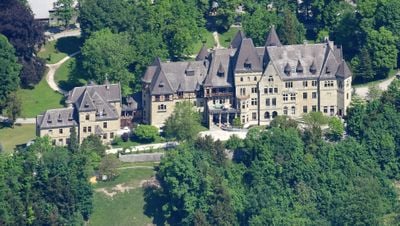
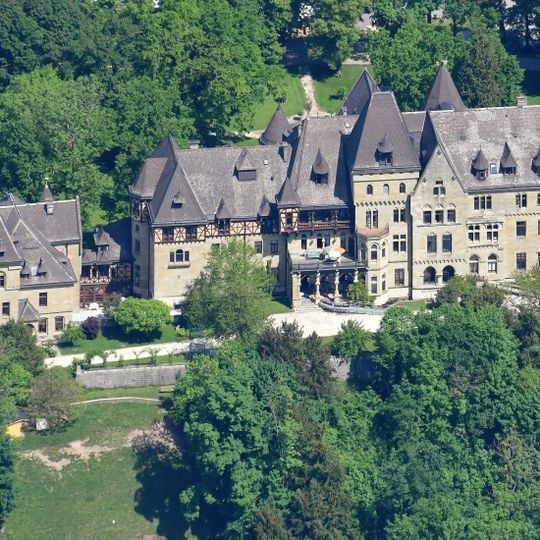
Schloss Cumberland is a castle of light grey stone with dark grey steep roofs, built as connected wings on a hill above Gmunden. Its left wing has a tall main block with a projecting gabled bay and a square tower with a red-brown conical roof; a central block with a glass conservatory links to the taller right wing, which has two pointed roof towers and rows of rectangular windows with green shutters. Brown half-timbered gables sit between the wings.
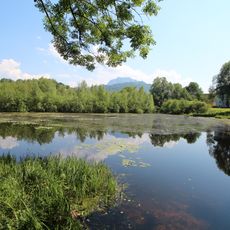
After Prussia annexed the Kingdom of Hanover in 1866, King George V went into exile in Vienna. His son Ernst August, 3rd Duke of Cumberland, bought land above the Krottensee near Gmunden and had Ferdinand Schorbach design a Tudor-style residence; construction began on 15 June 1882 and the family moved in on 15 September 1886. From 1886 until his death in 1923 the castle was the seat of the exiled crown prince.
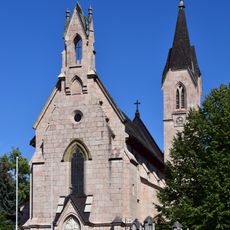
The castle held the Guelph treasure, whose highlight was the Guelph Bible. Its chapel, added a few years after the main building, has altar paintings from the school of Lucas Cranach. The Hanoverians also funded the Protestant church in Gmunden (1871–75), and the town named Georgstraße after King George V in gratitude.
The castle functions today as a state care facility and can be viewed from the outside by visitors. Those who visit should expect that access to the interior is not possible.
The castle's mausoleum lies beneath the terrace on the east side of the main building, entered through a modest structure with a double wooden door on the north side. Its T-shaped interior is not open to the public and holds the sarcophagus of Prince Christian (1885–1901) and the grave of Princess Marie (1849–1904).
The community of curious travelers
AroundUs brings together thousands of curated places, local tips, and hidden gems, enriched daily by 93,627 contributors worldwide.