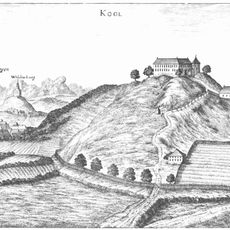
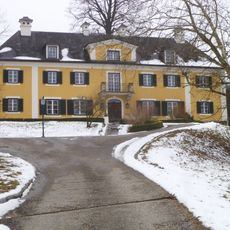
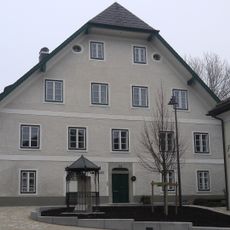
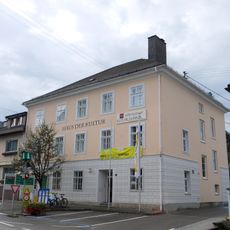
Schloss Kogl, 18th-century stately home in Sankt Georgen im Attergau, Austria.
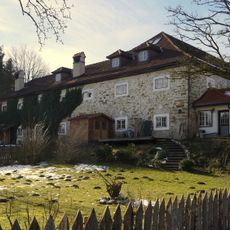
Schloss Kogl is a stone residence built in the 18th century with multiple floors containing decorated rooms, frescoed halls, and a hunting-themed dining area. Surrounding parkland adds to the overall composition of the estate.
The Khevenhüller family acquired the Kogl lordship in 1581. Around 1710, Franz Ferdinand Graf Khevenhüller commissioned Linz architect Johann Michael Prunner to plan a new castle at the foot of the Koglberg, replacing the outdated medieval fortress. In 1810 the Khevenhüller counts sold Kogl to Vienna court advocate Andreas von Pausinger; in 1861 it passed to Baron Mayr von Melnhof and in 1884 to his daughter Theodora on her marriage to Count Adalbert von Kottulinsky. From 1943 the Nazi Sonderstab Rosenberg used the castle, and after 1945 an American corps general resided there; the Mayr-Melnhof family has owned it again since 1956.
The staircase and gallery frescoes depict scenes from Ferdinand Raimund's play "Der Verschwender". Josef Engelhart began them in 1913 with Franz Hohenberger; after a pay dispute and the outbreak of World War I, Eduard Komlóssy completed the cycle.
Visiting requires advance notice through the property management. The exterior grounds can be viewed, but the interior rooms remain private and off-limits to casual visitors.
From 1943 the Sonderstab Reichsleiter Rosenberg, a Nazi looting unit, occupied the castle, and paintings taken from it were still being sought long afterwards. After 1945 an American army corps general lived here. The Mayr-Melnhof family has owned it again since 1956.
The community of curious travelers
AroundUs brings together thousands of curated places, local tips, and hidden gems, enriched daily by 93,900 contributors worldwide.