Itter Castle, 19th-century castle in Itter, Austria
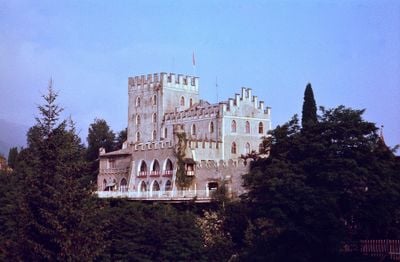
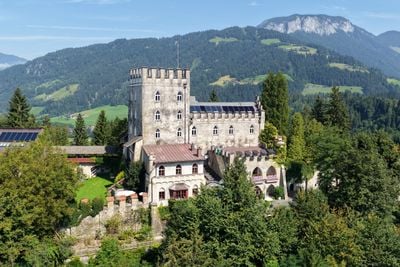
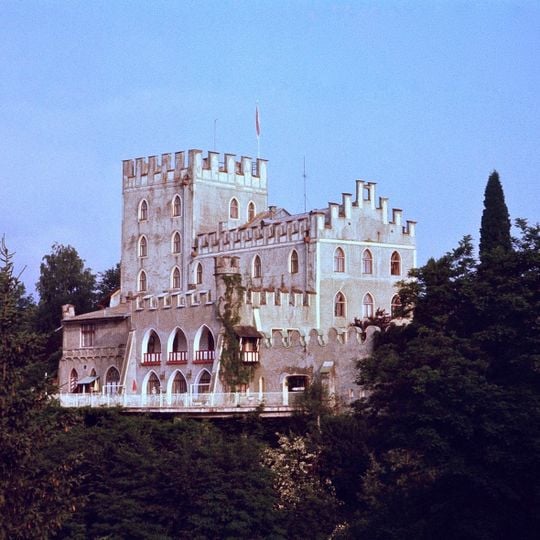
Itter Castle is a 19th-century building erected from 1878 on the foundations of an earlier fortress, remodeled in a Tudor Revival style after 1902. Its pale grey stone walls rise from a stone base, with a tall square crenellated tower on the left, a lower crenellated block beside it, and a gabled section with stepped edges to the right. Rows of arched windows, some grouped in pairs, sit above a terrace with a white railing; remains of two bergfrieds and a connecting wing from the old castle survive.
A fortress at the site was first recorded in a 1241 deed, with earlier constructions possibly dating to the 10th century; it guarded the Regensburg estates against Salzburg until the valley passed to Salzburg in 1312. Peasants destroyed it in 1526 and it was rebuilt in 1532, later decaying after the administration moved to Hopfgarten. Paul Spieß built the present castle on the old foundations from 1878. From 1943 to 1945 it was a Dachau subcamp holding French VIP prisoners.
Sophie Menter, a pianist and pupil of Franz Liszt, bought the castle in 1884 and made it a musical meeting place. Liszt himself stayed there, and in 1892 Pyotr Ilyich Tchaikovsky orchestrated one of his compositions during a visit. Menter sold the property in 1902.
The castle remains in private hands, and visitors need permission from the owner before entering the grounds. It sits roughly 5 kilometers south of Wörgl and is best reached by car from the nearby town.
In May 1945, an unusual alliance formed when American soldiers fought alongside German Wehrmacht troops to protect French prisoners against an attack by Waffen-SS forces. This rare partnership between enemies in the war's final days reveals the complicated circumstances of the conflict's closing phase.
The community of curious travelers
AroundUs brings together thousands of curated places, local tips, and hidden gems, enriched daily by 92,893 contributors worldwide.