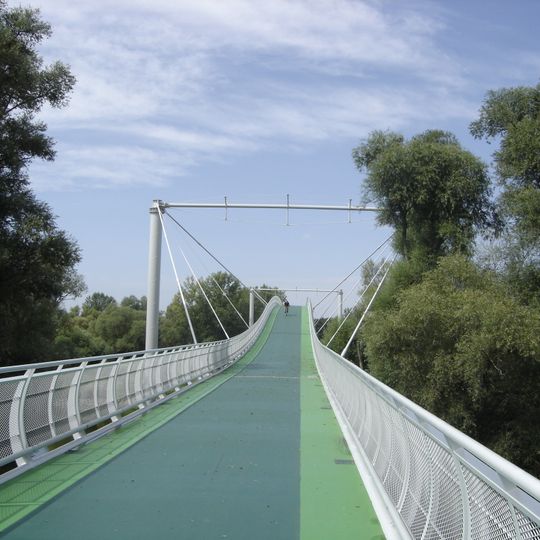
Cycling Bridge of Freedom, International bicycle bridge between Engelhartstetten, Austria and Devínska Nová Ves, Slovakia
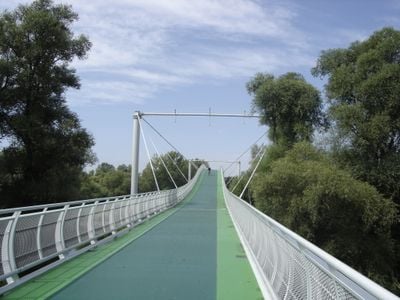
The Cycling Bridge of Freedom is a bicycle and pedestrian crossing over the Morava River that stands 21.5 meters high with a 4-meter wide path connecting two countries. The modern steel structure stretches 525 meters linking the Austrian town of Engelhartstetten directly to the Slovak village of Devínska Nová Ves.
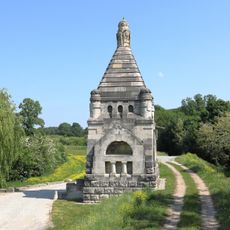
A partly stone bridge with wooden spans over the March stood here from 1771, built under Maria Theresia; ice floes destroyed it in 1809 and Count Pálffy rebuilt it in 1813. Prussian troops blew it up in 1866, and after ice wrecked it again in 1880 it was never rebuilt, leaving only a ferry and the stone arches still visible on the Austrian bank. The present bridge, designed by Milan Beláček, opened on 22 September 2012.
The name was chosen in 2012 after a public vote in Bratislava Region, where the winning suggestion was "Most Chucka Norrisa"; Austrian partners had proposed Maria-Theresien-Brücke. The final name, agreed by both sides, honours people who died trying to cross the March to freedom. The bridge is a junction of long-distance cycling routes, including EuroVelo 13, the Iron Curtain Trail.
The deck is 4 metres wide, so emergency vehicles can cross as well as cyclists and pedestrians. Because the March is a border waterway, the bridge keeps a clearance of at least six metres for patrol boats. The route follows the line of the old bridge, and the stone arches on the Austrian bank can still be seen from the path.
The bridge stands on the site of the old March crossing, and its supports were built over the remains of the Maria Theresa-era bridge embankment and original pilings found during archaeological work. The stone bridge arches on the Austrian bank are still visible in the landscape.
The community of curious travelers
AroundUs brings together thousands of curated places, local tips, and hidden gems, enriched daily by 94,851 contributors worldwide.