Osterburg, Medieval castle ruin in Haunoldstein, Austria.
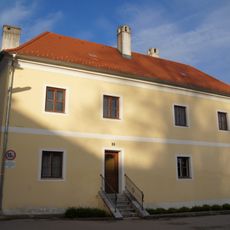
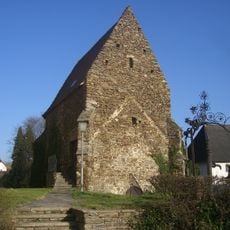
Osterburg is a castle ruin on a triangular rock plateau above the Pielach gorge in Haunoldstein. Its 13th-century Romanesque bergfried is about ten metres across with walls up to two metres thick, and the three-storey, three-winged palas from the early 15th century retains a double latrine oriel on corbels and Gothic shoulder-arched portals.
A first castle was probably built in the last quarter of the 12th century by unknown builders. Around 1200 the Counts of Peilstein held it as a free property; Count Friedrich V of Peilstein died there in 1209. In 1405 Rudolf Turso von Tiernstein had the palas enlarged, and in 1766 Zeno Count Montecuccoli had the medieval defences and part of the dwellings demolished, using the stone to extend Mitterau Castle.
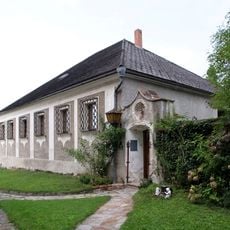
The name Osterburg was adopted by the Häusler family, who lived in the castle in the second half of the 13th century and called themselves after it. The three-storey palas still bears remains of seven stone coats of arms that decorated its wall from the mid-17th century. The top floor long served as a granary.
A road from Pielachhäuser, a hamlet of Haunoldstein, leads up to the ruin and its farmyard. A public road now runs between the Romanesque bergfried and the palas, on the line of the former outer courtyard. The ground on the triangular rock plateau is uneven, and the south side drops steeply into the Pielach gorge.
The round tower still shows traces of how medieval builders arranged the stone blocks in its interior, revealing construction techniques from that era. Visitors can observe these building methods directly by examining the remaining stonework.
The community of curious travelers
AroundUs brings together thousands of curated places, local tips, and hidden gems, enriched daily by 93,001 contributors worldwide.