Martinskirche Deutsch Schützen, Medieval church in Deutsch Schützen-Eisenberg, Austria
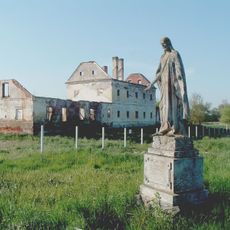
Martinskirche Deutsch Schützen is a ruined former parish church standing about 800 metres outside the village centre. Its surviving one-bay Gothic choir has a five-eighth apse with buttresses, and the vault rests on slender round services and rib bundles. A sacrament niche and a gravestone of Georg Debreczenyi (died 1593) remain in the south inner wall.
The present church was built around 1400 and baroquized in 1751; it served as parish church until 1938. Excavations in 1970 and 1971 uncovered foundations of a Romanesque church and a Roman-era cemetery. Two double capitals from that Romanesque church survive, and a bell from the first half of the 13th century is now in the Pfundner collection in Vienna.
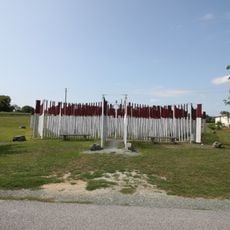
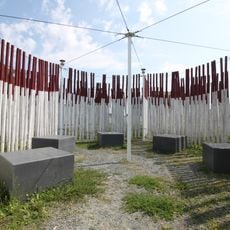
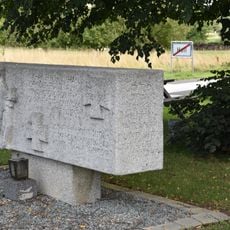
The village is also known as Livio-Čjeka in Croatian and Németlövő-Csejke in Hungarian, reflecting the multilingual Burgenland setting. A memorial plaque donated by Austrian ambassador to Israel Herbert Kröll stands at the church, the assembly point for some 850 Jewish forced labourers in March 1945. In 1995 the grave of the massacre victims was rediscovered, and on 13 September they were reburied at the site under halachic rules by Chief Rabbi Paul Chaim Eisenberg.
The church stands about 800 metres outside the present village centre, in the area of the former centre of St. Martin. Roof and west tower collapsed in 1945 and the building was partly demolished, so it is a ruin and not open to visitors. The memorial plaque for the Jews gathered here in 1945 is mounted on the church.
A bell from the first half of the 13th century that originally belonged to the church is now preserved in the Pfundner collection in Vienna. The object shows the craftsmanship and importance this church held in earlier times.
The community of curious travelers
AroundUs brings together thousands of curated places, local tips, and hidden gems, enriched daily by 93,939 contributors worldwide.