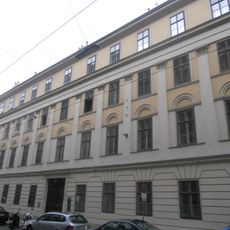
Hauptmünzamt, Vienna, Historical mint building in Landstraße, Austria.
The Hauptmünzamt is a free-standing monumental building on Am Heumarkt, erected 1835–1838 by architect Paul Wilhelm Eduard Sprenger around a large rectangular courtyard. Its five-axis central risalit carries a three-part portico of paired Doric columns, an altan with iron railing, and an attic with relief figures of Mercury, Apollo, Diana and Venus beneath the inscription "Rei Monetariae".
The Austrian Mint was established in 1194 and initially produced coins from silver sourced from the Danube River to meet the financial needs of the Babenberg dynasty. From this early foundation, it developed into an institution that remained important for Austria's currency and economic stability across the centuries.
The attic reliefs depict Mercury, Apollo, Diana and Venus, probably standing for four metals, and the central field reads "Rei Monetariae". Above them Josef Klieber's group shows Justitia and Fortuna flanking two griffins that carry the state coat of arms, with the year MDCCCXXXVII (1837) below. In the cash hall a painted wooden retable behind a Justitia figure bears the inscription "KAYS KÖNIGL HAUPT MÜNZ 17 AMT 53".
The building stands free at Am Heumarkt 1 in Landstraße, its main front facing the square; the three round-arched portals open into a three-aisled vestibule with raised side aisles reached by stone steps. The stamp collection occupies a long room on the second floor, lit from the courtyard side. Enter from the Heumarkt front to see the columned portico and the attic figures before going in.
The building produces the Vienna Philharmonic bullion coin, introduced in 1989, which has become one of the most traded and recognized precious metal investment pieces worldwide. This coin remains highly sought after by collectors and investors today.
The community of curious travelers
AroundUs brings together thousands of curated places, local tips, and hidden gems, enriched daily by 94,252 contributors worldwide.