Bauernberg, Cultural park in Linz, Austria.
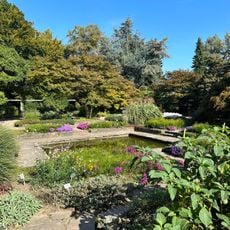
Bauernberg is a Jugendstil park laid out between 1911 and 1915 by city garden director Josef Schweiger on the slopes of the Freinberg massif in Linz. The winding Bernardisstraße park path crosses the grounds in serpentines, linking lawns, old trees and shrubs with works such as the Berggeist sculpture and the Neptunbrunnen. Parts of the park are protected as monuments.
The land was originally a sand quarry until the Linzer Verschonerungsverein purchased it in 1885 and began transforming it into a public park. This conversion marked the shift from industrial extraction to recreational space for the city.
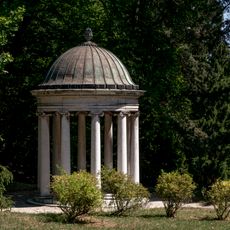
The park's name comes from the Bauernberg hill, and its Jugendstil layout by Josef Schweiger (1911–1915) still shapes how people use it: winding paths, open lawns and old trees. Ludwig Hatschek donated the Berggeist sculpture by Adolf Wagner von der Mühl in 1912, and the Aphroditentempel was bought from the Munich art market in 1913. The bronze Aphrodite figure placed there in 1942, a gift from Adolf Hitler, was removed in 2008 on the order of mayor Franz Dobusch.
The Bernardisstraße runs through the grounds in serpentine curves as a park path, linking the streets Auf der Gugl, Roseggerstraße and Sandgasse; the park borders the Landwirtschaftskammer grounds, formerly the Hatschekvilla park. Parts of the site are listed as protected monuments, so stay on the paths. The terrain lies on the slopes of the Freinberg foothills, so expect gradients.
The park contains a marble temple with ten Ionic columns standing on a two-tiered base and topped with a Welsche dome decorated with simple stucco medallions. This neoclassical structure was acquired from Munich's art market in 1913 and adds an unexpected architectural presence to the grounds.
The community of curious travelers
AroundUs brings together thousands of curated places, local tips, and hidden gems, enriched daily by 94,598 contributors worldwide.