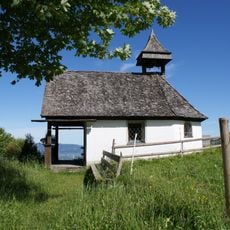
Versuchsseilbahn Batschuns, Aerial lift in Zwischenwasser, Austria.
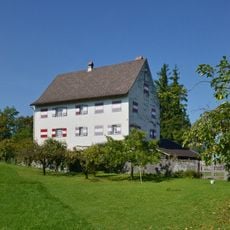
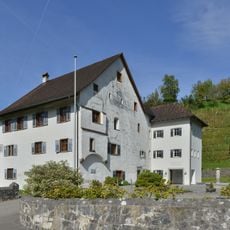
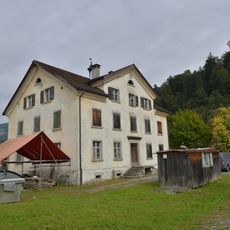
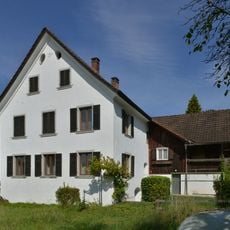
The Versuchsseilbahn Batschuns was a reversible aerial lift running about 450 m horizontally (472 m along the slope) from a valley station at 683 m to a mountain station at 825 m in Suldis, a height difference of 142 m. One support stood roughly halfway along the line, which ran northwest to southeast. The valley station survives as the Peter family's house; the Suldis station is a ruin holding a deflection sheave with brake linkage and cable anchor posts.
Karl Peter built this experimental installation in 1947 to prove that automated cable cars could operate without constant personnel supervision. Officials recognized the potential of this idea and later used the results for more modern mountain rail systems.
The site shows how a small technical solution influenced the thinking of people who later built mountain railways. The remaining parts at the upper station still reveal how the first automated systems worked.
The lower station, now the Peter family's home, stands beside the Schulertobel in Batschuns; it is not open to the public. The upper station in Suldis is a ruin holding the deflection sheave with brake linkage and the support-cable bollards. Both are reached on foot; no cable-car service remains.
Karl Peter received Austria's first permit to build fully automatic cable cars after this test line was approved. The first real passenger application of his concept was the Lech–Oberlech mountain railway; the Brusino Arsizio–Serpiano lift, the Härmelekopf and Graseck lines followed, and the Graseckbahn still keeps its original form.
The community of curious travelers
AroundUs brings together thousands of curated places, local tips, and hidden gems, enriched daily by 94,593 contributors worldwide.