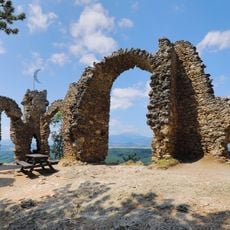
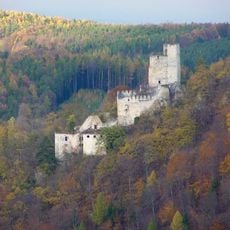
Burg Grimmenstein, Medieval castle ruins in Grimmenstein, Austria.
Burg Grimmenstein is a castle ruin perched on the southeastern slope of Kulmriegels at 660 meters elevation, featuring a high castle built on rocky outcrops and lower fortification walls below. The site combines multiple structures that illustrate different phases of medieval defensive design.
A first fortification here dates to the 12th century, and stone walls were built in the 13th century around a core of about 25 by 30 metres. Albert von Grimmenstein is documented between 1144 and 1158 as a vassal of Count Eckbert III of Formbach-Pitten; his son Albert took part in the Fifth Crusade and is named at the siege of Damietta in 1218. The family died out around 1309, and the castle later passed to the dukes and was sold by Emperor Frederick III in 1444.
The name Grimmenstein appears in medieval deeds, while the labels Vordergrimmenstein, Hochgrimmenstein and Hintergrimmenstein for the three Kulmriegel fortifications date only from the 19th century. The village a few kilometres south was called Am Treitl until the 20th century, when it took the castle's name. Since 1961 the site has housed a museum room with old coats of arms and knightly armour.
The castle stands on a rock spur at 660 m, about 100 m below the Kulmriegel summit, reached on foot through forest; the former drawbridge is replaced by a fixed bridge. The site opened to visitors in April 2016 and is a listed monument. Sturdy shoes are useful on the slope.
The castle's name is misleading: the counts Stella-Caracciolo, who owned it from 1720 to 1848, lived in Italy and none of them ever visited their Austrian property. The village a few kilometres south was called Am Treitl until the 20th century, when it took the castle's name.
The community of curious travelers
AroundUs brings together thousands of curated places, local tips, and hidden gems, enriched daily by 94,023 contributors worldwide.