Kalvarienbergkirche zum blutschwitzenden Heiland, Bruck, Baroque church on southern hill in Bruck an der Mur, Austria
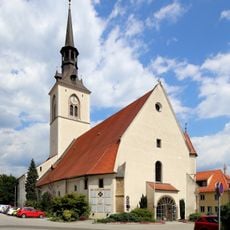
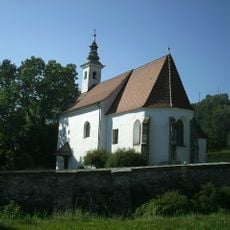
The Kalvarienbergkirche zum blutschwitzenden Heiland is a Baroque hall church on a hill south of Bruck an der Mur, built in 1718 and 1719. Its rectangular nave has a recessed choir, pilasters and a surrounding cornice; the three-axis facade with corner pilasters and a gable aedicula between volute bands. A roof turret with a segmental-arched gable carries a pyramidal spire from the second half of the 19th century.
The church was built from 1718 to 1719 following a vow made during the plague epidemic of 1716 in Styria. It emerged as a response to that crisis and later became a local pilgrimage site.
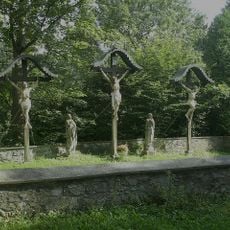
The dedication "zum blutschwitzenden Heiland" refers to Christ sweating blood in Gethsemane, not to a local bleeding-Christ legend. The church was vowed during the plague epidemic of 1716, and the oil group of the Mount of Olives that gave the church its name is no longer in the altar area. Nearby stands the Calvary complex with a crucifixion group on a masonry plateau and several small chapels, now empty.
The building has not held religious services since 1969 and requires extensive restoration work to prevent further deterioration. Visitors should be prepared for a partially deteriorated structure and navigate carefully around the site.
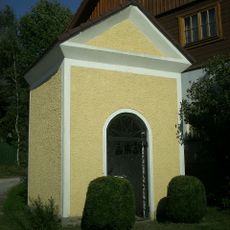
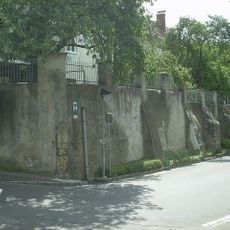
Beside the church stands a Calvary complex with a crucifixion group set on a masonry platform and several small accompanying chapels. These chapels now stand empty and unused but together form a historical ensemble with the main building.
The community of curious travelers
AroundUs brings together thousands of curated places, local tips, and hidden gems, enriched daily by 94,598 contributors worldwide.