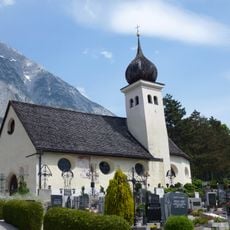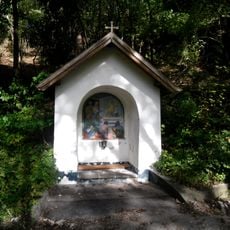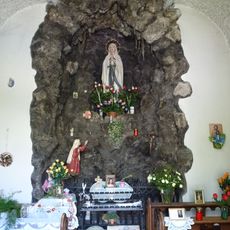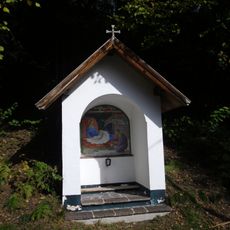
Mariahilf chapel, Religious chapel in Telfs, Austria.
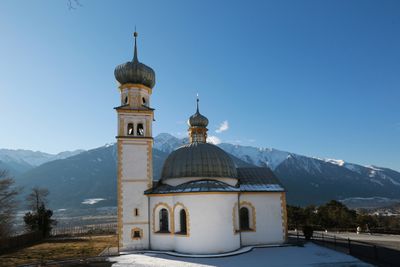
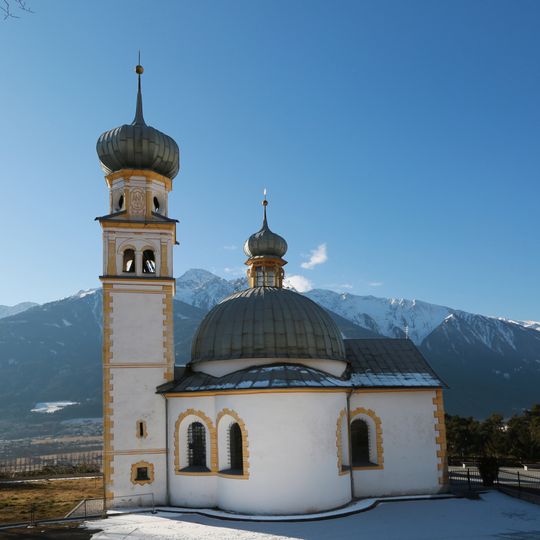
The Mariahilf Chapel is a Baroque domed rotunda modelled on the Mariahilf Church in Innsbruck. A circular central space is joined by three semicircular apses with curved half-domes, topped by an octagonal lantern with tall windows and an onion dome. A square tower with a sacristy on its ground floor adjoins the middle apse to the east, and a square forebay with a groin vault stands to the west. Painted quoins and pilasters with a triangular pediment decorate the exterior.
Friedrich Kranewitter and his brother Johann, a curate in Ötz, built the first chapel at their own expense; on 10 August 1648 the Brixen auxiliary bishop Jesse Perkhofer consecrated it with one altar under the patronage of the Visitation. Pilgrimage grew so quickly that a larger church was needed. Construction of the new building began in 1692 under the Ötztal master mason Josef Keil the Elder, the high altar by the Stams sculptor Andreas Thamasch is documented by receipts from 1693, and the building was completed in 1694, the tower in 1696. On 27 August 1698 Prince-Bishop Johann Franz Khuen von Belasi consecrated it.
The chapel is dedicated to the Visitation of Mary, and its main altar holds a copy of the Maria-Hilf image from Innsbruck Cathedral. Until the 19th century, childless women made pilgrimages here to pray for children; the pilgrimage later declined and was replaced by Maria Locherboden. The small black figure on the altar is said to have inspired Gertrud Fussenegger's Christmas story "Mohrenlegende".
From Telfs centre, walk north along Untermarktstraße, then northeast on Saglstraße to Birkenbergstraße, which climbs somewhat steeply to the Tenniscafé; from there it is about 350 metres to the chapel. Allow roughly 35 minutes on foot from the town centre. The chapel stands at Birkenberg 6, northeast of the centre and west of the St. Georgen-Siedlung.
The small black figure on the high altar is said to have inspired Gertrud Fussenegger's Christmas story "Mohrenlegende"; she spent part of her childhood on the farm next to the chapel, which stood until 2014. The writer Karl Schönherr built the villa directly behind the chapel in 1913 and lived there until 1924.
The community of curious travelers
AroundUs brings together thousands of curated places, local tips, and hidden gems, enriched daily by 94,425 contributors worldwide.