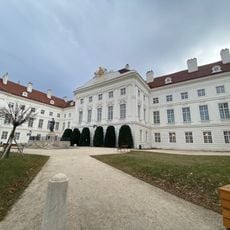
Pathologisches Institut, Protected heritage building in Alsergrund, Vienna, Austria.
The Pathological Institute is a protected heritage building in Alsergrund featuring a symmetrical facade with distinct side wings and a flat central projection. The structure displays Rundbogenstil architecture, a 19th century design approach using rounded arches.
Construction took place between 1859 and 1862 under architect Ludwig Zettl, with the building opening on May 24, 1862 as a medical research facility. It served as a key center for pathology research in Vienna for many decades.
On the attic, beneath a crowning group of sculptures, runs the Latin dedication Indagandis sedibus et causis morborum, "the investigation of the seats and causes of diseases". It quotes the title of the five books De sedibus et causis morborum per anatomen indagatis by Giovanni Battista Morgagni, founder of modern pathology. The inscription ties the building to the anatomical method that defined its discipline.
The building is not open to visitors: it houses the Center for Brain Research of the Medical University of Vienna, a working research facility. The lecture hall D, seating up to 250 people, is part of the university campus and is used for teaching. Access is limited to students and staff; the exterior can be viewed from Spitalgasse.
In 2000, the building was converted into a neuroscience research center, shifting from its original role as a pathology laboratory. This transformation reflects how medical research priorities evolved over time.
The community of curious travelers
AroundUs brings together thousands of curated places, local tips, and hidden gems, enriched daily by 94,255 contributors worldwide.