Castle of Gaasbeek, Renaissance castle museum in Lennik, Belgium
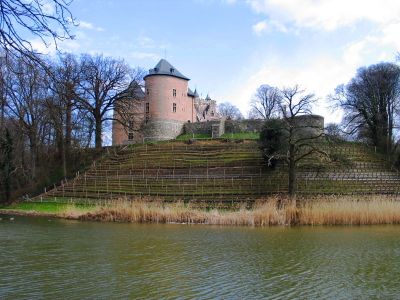
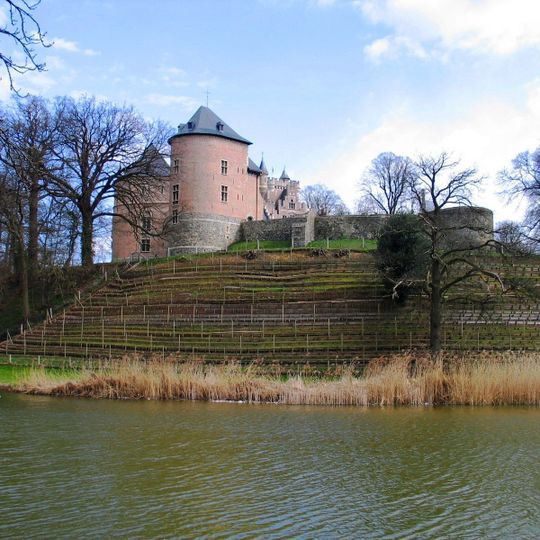
Gaasbeek Castle stands on a grassy rise, its irregular polygonal plan enclosed by a wall. The central block has a grey slate roof and a tall spire tower; two round towers with conical roofs flank it on the left and one on the right. Pale stone walls with rows of rectangular windows rise above a 13th–15th-century base of local rubble stone, and a small formal garden with low hedges and paths lies in front.
A fortress was probably built here around 1240 by Godfrey of Leuven to defend the Duchy of Brabant against the County of Hainaut. In 1388 Brussels troops razed it in revenge for the murder of Everard t'Serclaes by followers of the lord, Sweder of Abcoude, who rebuilt it. Lamoral, Count of Egmont, bought it in 1565 and was beheaded in Brussels three years later.
The Visconti family's emblem, the biscione, appears on wooden panelling and mantelpieces throughout the castle. The Egmont Room holds Louis Gallait's painting of Egmont's final moments, alongside an anonymous portrait and Erwin Olaf's 2012 photographic version. The castle's logo also uses the vertically coiled dragon.
The castle reopened in 2024 after restoration work carried out between 2021 and 2024, with a new route through the decorated state rooms. The 50-hectare park, with its three ponds and the baroque Sint-Gertrudis chapel, can be visited separately. The 1.5-hectare terrace garden by the main avenue was redesigned as a living museum in 1996-1997.
The Visconti biscione, a crowned blue serpent swallowing a man, recurs on the castle's wooden panelling, chimney pieces and even its logo, a trace of the Milanese family that acquired Gaasbeek through marriage. Marie Arconati Visconti, the last private owner, left the domain to the Belgian State in 1921; it opened to the public in 1924.
The community of curious travelers
AroundUs brings together thousands of curated places, local tips, and hidden gems, enriched daily by 93,449 contributors worldwide.