Lake Bütgenbach, lake in Bütgenbach, German-speaking Community of Belgium, Belgium
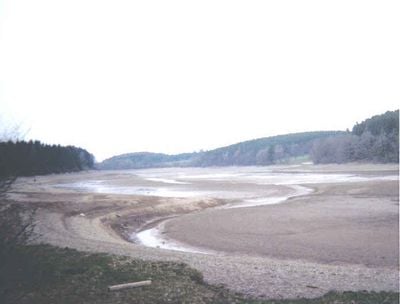
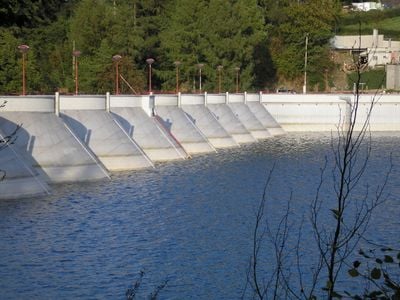
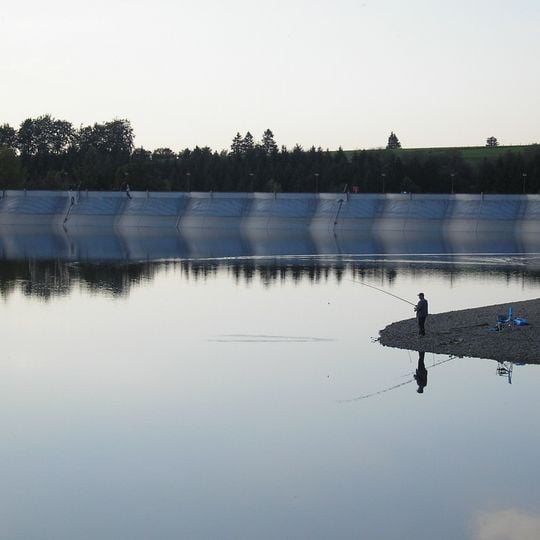
Lake Bütgenbach is a 120-hectare reservoir on the Warche River in Belgium's East Cantons, formed by a 23-metre-high dam built from 1929 to 1932. Its dark blue dam face is divided into broad panels, with a railing along the crest. At low water, a wide basin of cracked mud and pale silt is exposed, with a shallow stream meandering through it.
The dam was built from 1929 to 1932 on the Warche at its confluence with the Holzwarche, creating a 120-hectare reservoir. The old road from Bütgenbach to Berg was rerouted over the dam. The power station produces about 2.2 million kWh per year and is operated by Electrabel. In autumn 2003 the lake was almost completely drained for dam maintenance, carried out in 2004, and refilled that same year.
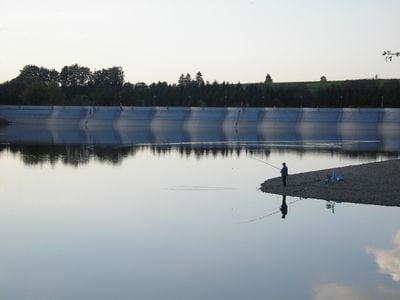
The lake's name appears in both French and German forms, reflecting the bilingual East Cantons. The former Bütgenbach station on the west bank once served a tourist train; the site now lies near the water. Motorboats are banned, so sailing, windsurfing, kayaking, pedal boating, swimming and sport fishing shape how the water is used.
The lake lies in the East Cantons on the edge of the High Fens plateau, with the dam on the Warche and the Holzwarche joining nearby. Motorboats are not allowed, so the water is used for sailing, windsurfing, kayaking, pedal boats, swimming and sport fishing. The western shore once held Bütgenbach station, served by a tourist train.
In autumn 2003 the lake was almost completely drained for maintenance on the dam, which was carried out in 2004 and followed by refilling that same year. The drawdown exposed the basin floor, the broad mudflats visible when water levels drop. The power station, run by Electrabel, produces about 2.2 million kWh a year.
The community of curious travelers
AroundUs brings together thousands of curated places, local tips, and hidden gems, enriched daily by 93,668 contributors worldwide.