Langemark German war cemetery, German war cemetery in Langemark-Poelkapelle, Belgium.
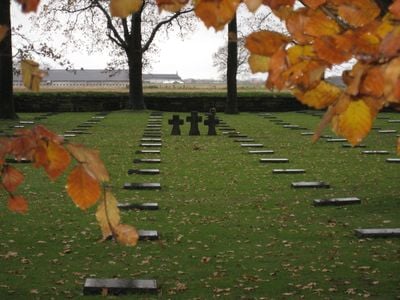
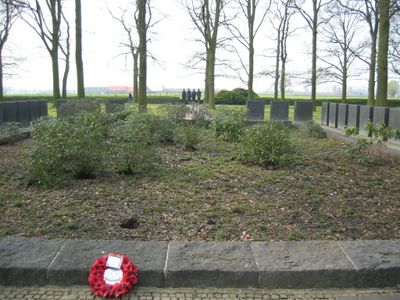
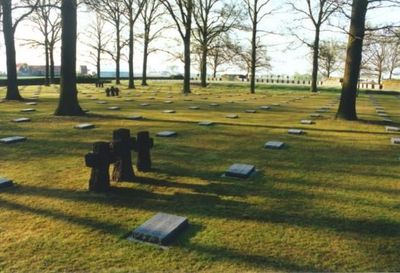
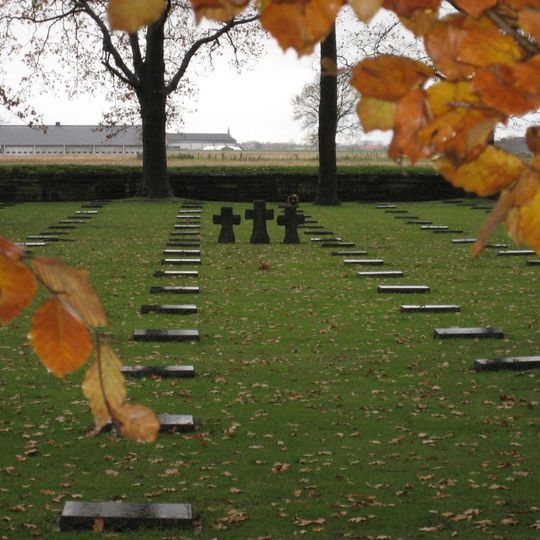
Langemark German war cemetery is a flat lawn of dark grey stone slabs set flush with the ground in straight rows, with three dark stone cross-shaped markers standing between two central rows. A low stone wall and a building line the far edge. Near the entrance, a rectangular grey stone block bears a wreath of red artificial poppies.
This site began in 1915 as a small burial ground during intense fighting on the Western Front and was reorganized in 1932 into its current form. The expansion reflects the scale of losses throughout the war.
The four mourning soldiers at the front of the cemetery were cast in bronze by sculptor Emil Krieger and installed in 1956; they are said to stand guard over the fallen. The cemetery is kept by the Volksbund Deutsche Kriegsgräberfürsorge, and on 22 May 2009 a Flemish band played the German soldiers' lament "Ich hatt' einen Kameraden" on bagpipes at a Belgian-British-German ceremony.
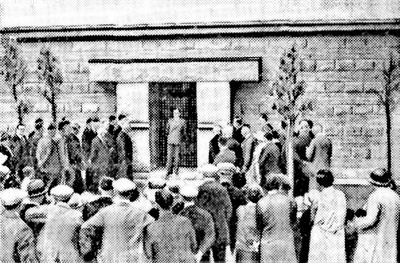
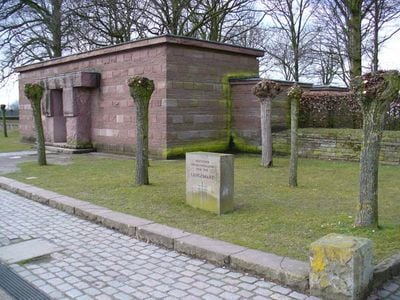
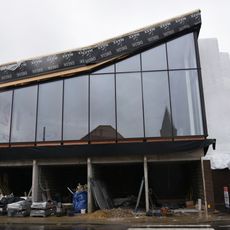
Access from the car park passes through a dark tunnel-like information and remembrance building, where screens show the First World War, the Flanders battles and the cemetery's history, while embrasures on the opposite side open onto the graves. The grounds lie at the northern exit of Langemark on the road to Houthulst and Diksmuide, and the site receives about 100,000 visitors a year.
The mass grave holds 24,917 servicemen, among them the fighter ace Werner Voss. The Volksbund later identified almost 17,000 of the dead and cast their names on bronze plaques fixed to heavy stone blocks around the grave. The four mourning soldiers behind it were cast in bronze by Emil Krieger and added in 1956.
The community of curious travelers
AroundUs brings together thousands of curated places, local tips, and hidden gems, enriched daily by 94,054 contributors worldwide.