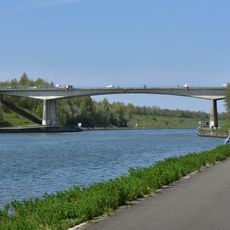
Veldwezelt-Hezerwater, Archaeological excavation in Veldwezelt, Belgium
Veldwezelt-Hezerwater is an archaeological excavation containing multiple Paleolithic layers along the Albert Canal between Veldwezelt and Maastricht. Stone tools and bone remains from several hunting camps were uncovered here, and the exposed earth walls are now protected by steel structures.
The site was systematically studied between 1998 and 2003, revealing evidence of four separate hunting camps and a flint quarry in the valley. These discoveries document one of the oldest known human settlements in Belgium.
The site's name links the village of Veldwezelt with the Hezerwater stream, a tributary of the Meuse where Neanderthals repeatedly returned to collect flint from the gravel bed. The many tested cores found on the slopes show that flint extraction, not only hunting, drew people to this spot. No Neanderthal bones survive here; the attribution rests on stone tool types and the assumed age of the layers.
The site lies in the Vandersanden clay quarry between Veldwezelt and Maastricht, on the east side of the Albert Canal, and is not set up as a visitor attraction: there are no guided tours or marked paths. Large-scale clay extraction has continued here since 2002, so the terraced sections are working quarry ground. View the stepped earthen profiles from a safe distance and keep off the exposed faces.
The oldest layers here, beneath the Rocourt soil complex, are dated to about 133,000 years BP and are considered the earliest traces of Neanderthal presence in Flanders and the oldest in-situ occupation evidence in Belgium. No Neanderthal bones were found; the attribution rests on stone tool types and the assumed age.
The community of curious travelers
AroundUs brings together thousands of curated places, local tips, and hidden gems, enriched daily by 94,978 contributors worldwide.