Castle of Zellaer, Gothic Revival château in Bonheiden, Belgium
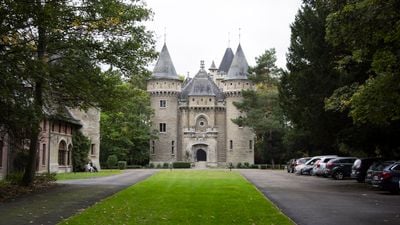
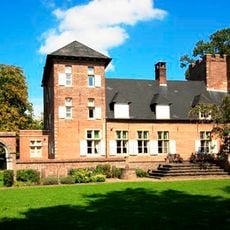
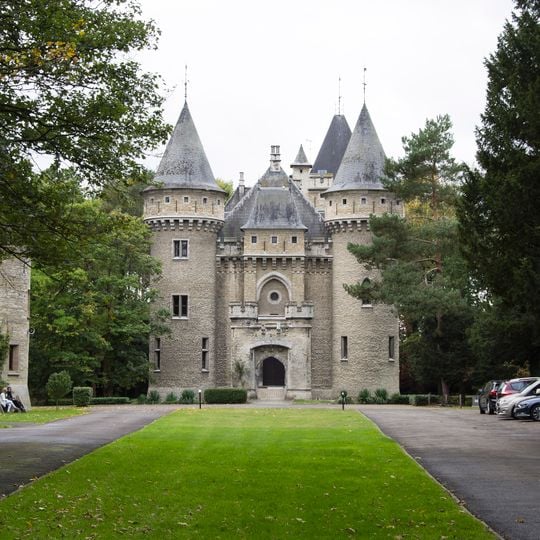
Castle of Zellaer is a Gothic Revival château north of Bonheiden's centre, built on an artificial island in a large pond. Its rectangular plan has round corner towers with conical slate roofs, a taller tower on the right, and a central arched entrance beneath a round window, with battlements and pinnacles above. White sandstone blocks from the demolished forts of Vilvoorde form the walls.
A castle already stood here before the present one: a 20 October 1836 sale notice describes a square Gothic building with four towers and a bell turret, and demolition revealed wooden piles possibly from the 13th century. Wouter Berthout, lord of Mechelen, may have commissioned it, with canon Arnold van Zellaer as first owner. The current castle was built 1888–1892 for baron Gustavius Eugenius Leo Maria Gislainus de Vrière to plans by Mechelen architect Heugenbaarts, using white sandstone from the demolished forts of Vilvoorde hauled by dependent farmers with horse and cart. Damaged in the First World War, it was restored from the late 1950s by priest Vincent d'Héu and opened in 1962 for the Foyer de Charité.
The castle's name comes from Arnold van Zellaer, an early owner of the medieval stronghold on this site. Since 1962 it has housed a community of the Foyer de Charité movement, founded by Martha Robin and brought here by the Franciscan priest Vincent d'Heu. Today it serves as a retreat centre for prayer and spiritual practice.
The castle stands on an artificial island in a large pond, reached by a stone bridge on the east side. It now houses a retreat centre run by the Foyer de Charité movement, so visits are not a standard tourist offer; check with the centre before planning a stop. The surrounding park, managed since 2017 by the Kempens Landschap foundation, retains several broad moats.
The white sandstone blocks in the walls came from the demolished forts of Vilvoorde; the farmers dependent on Zellaer had to haul them by horse and cart. The claim that the castle is a reduced copy of a Loire château has never been proven, though it resembles Sully-sur-Loire.
The community of curious travelers
AroundUs brings together thousands of curated places, local tips, and hidden gems, enriched daily by 94,035 contributors worldwide.