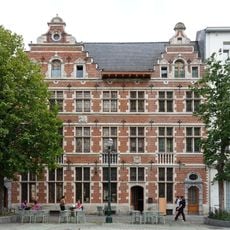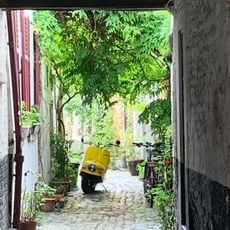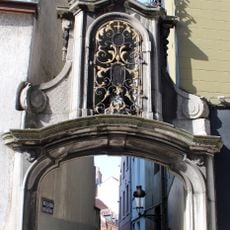
Petit-Château - Klein Kasteeltje, Tudor Revival building in Quays Quarter, Brussels, Belgium.
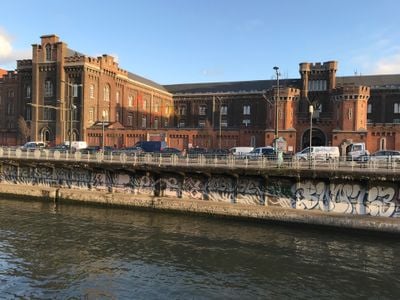
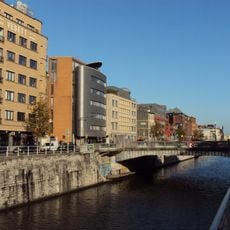
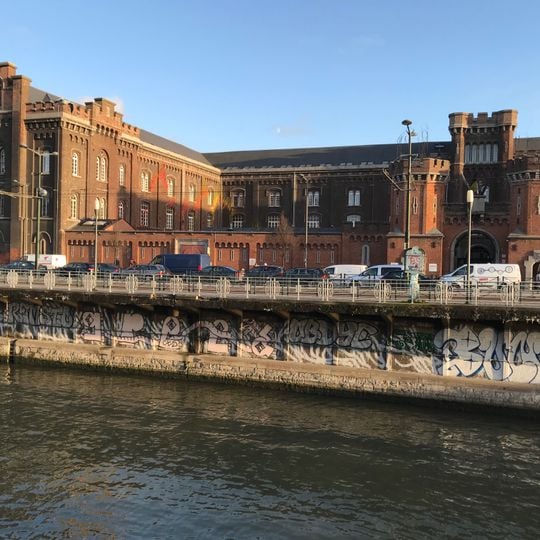
The Petit-Château is a former barracks built in 1852 in neo-Tudor style to plans by Captain Matthieu-Bernard Meyers, arranged around a courtyard in a U shape. Its dark brown brick ranges have arched windows with pale stone surrounds, and a projecting tower ends in a stepped, crenellated parapet with lighter stone caps. A low stone embankment wall covered in graffiti runs along the canal side.
The present Petit-Château was built from 1848 to 1852 to plans by Captain Matthieu-Bernard Meyers, replacing an earlier barracks of 1775. It served as an infantry barracks, then from 1944 as a prison for collaborators and for Italian immigrants refusing mine work. From 1951 to 1985 it was an army recruitment centre; since 1986 Fedasil runs it as an asylum seekers' centre.
The name comes from a 1560 patrician mansion, the Petit-Château or t'Slotje, that stood behind the present building and was later used as a barracks. Since November 1986 the complex has housed Fedasil's asylum reception centre, Belgium's oldest and largest, accommodating 800 asylum seekers and about forty unaccompanied minors.
The complex stands at boulevard du Neuvième de Ligne 27, along the Brussels-Scheldt sea canal. Trams and buses stop nearby, and Brussels-North station and the Sainte-Catherine and Comte de Flandre metro stations (lines 1 and 5) are within walking distance. The site is an active reception centre, so the grounds are not open to visitors.
The architect, Captain Matthieu-Bernard Meyers, beat established names such as Louis Spaak because looks mattered less than planting a military presence in the city. To carry the foundations, 2,000 piles were driven into the ground. The design sits between a fortified castle and a prison.
The community of curious travelers
AroundUs brings together thousands of curated places, local tips, and hidden gems, enriched daily by 94,383 contributors worldwide.