Munsterbilzen Abbey, Benedictine abbey in Bilzen, Belgium.
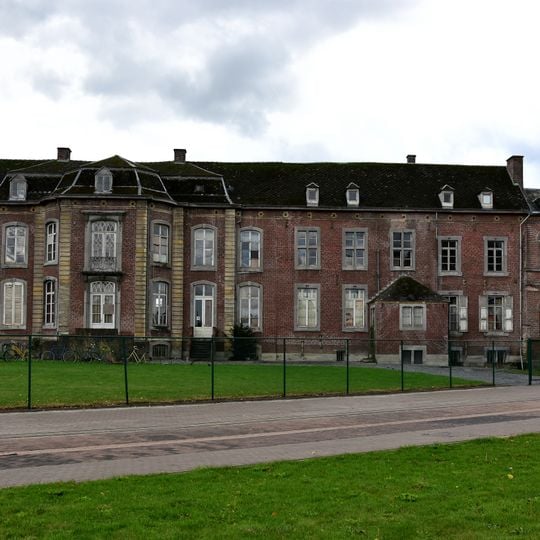
Munsterbilzen Abbey is a former Benedictine nunnery in Bilzen, near Maastricht. The surviving red-brick abbey building has a steep dark roof with small dormer windows, horizontal bands of lighter stone, and tall rectangular windows with light stone surrounds. An octagonal bay with tall windows on two levels projects from the left, while a lower entrance with a shallow triangular pediment stands on the right. A metal fence borders the lawn along the road.
Founded around 670 by Saint Landrada, the abbey was destroyed by Vikings in 881 and rebuilt in the third quarter of the 10th century as Monasterium Sancti Amoris. In 1794 the French dissolved the chapter and sold its goods; most buildings, including the abbey church, were demolished in the 19th century.
The village name Munsterbilzen comes from Belisia Monasterii, distinguishing it from Bilzen and Eigenbilzen. The abbey's Gospel, a Carolingian manuscript, contains a sentence added in 1130: "Tesi samanunga vvas edele unde scona" ("This community was noble and beautiful"), a key witness in the history of Dutch. The parish church preserves a Romanesque font and the tombstone of canoness Anna van Merode.
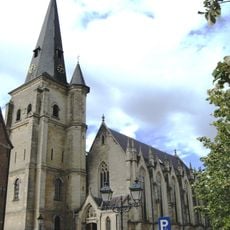
The abbey lies in Munsterbilzen, a village of Bilzen-Hoeselt near Maastricht. The surviving buildings stand along a paved road behind a metal fence and lawn; the parish church tower of 1565-67 and the abbess's house of around 1730-50 are the main points to find. Parts of the complex now house the Sint-Jozef medical centre, so the grounds are not freely open throughout.
The abbess held complete authority over Munsterbilzen and four neighboring villages, an unusual amount of power for a religious woman of her era. This control lasted until 1773 when she accepted the Prince-Bishop of Liège as her superior.
The community of curious travelers
AroundUs brings together thousands of curated places, local tips, and hidden gems, enriched daily by 93,669 contributors worldwide.