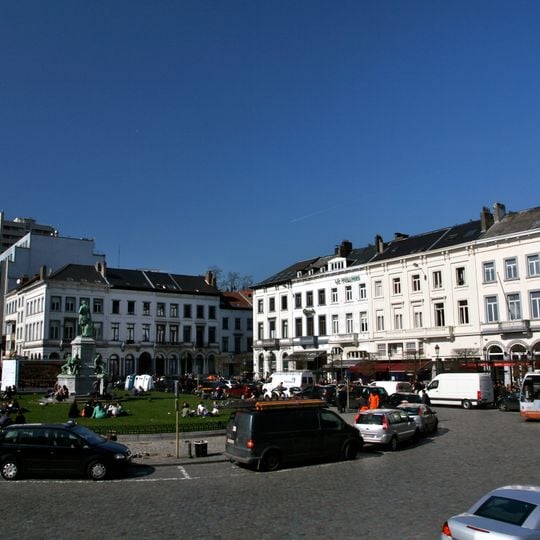
Place du Luxembourg, square in Brussels, Belgium
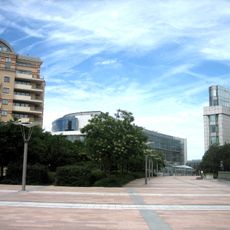
Place du Luxembourg is a broad cobblestone square in Brussels, mostly in Ixelles, between Rue d'Arlon and Rue du Luxembourg. In its centre stands Armand Cattier's Monument to John Cockerill, an industrialist leaning on an anvil, surrounded by figures of a glass-blower, mechanic, puddler and coal miner. Behind it, the former Leopold Quarter station entrance, a listed building, now houses the European Parliament's infopoint.
The square was laid out in neoclassical style between 1855 and 1861 as the forecourt of the new Leopold Quarter railway station, built in 1854–55 to plans by Antoine Trappeniers. Its name comes from the Brussels–Luxembourg railway line, not from a chapel. From 1989 the station tracks were covered and the Espace Léopold rose beside it; the station building was mostly demolished in 2004, leaving its central entrance.
The square's name comes from the Rue du Luxembourg and the Brussels–Luxembourg railway line, not from a chapel. Hotels around the square once carried names of towns on that line, such as the Hôtel du Cercle Namurois at No. 4, the Hôtel de la ville de Wavre at No. 5 and the Hôtel de Gembloux at No. 7. Locals call it Place Lux or Plux.
The square lies between Rue d'Arlon and Rue du Luxembourg, mostly in Ixelles with a small part in the City of Brussels. Brussels-Luxembourg station sits at its eastern edge, and metro stations Schuman (lines 1 and 5) and Trône (lines 2 and 6) are nearby. The wide pavements in front of the bars and restaurants fill up on Thursday and Friday evenings.
The square's nickname, Place Lux or Plux, is used by local European bureaucrats and journalists. The trash left by Thursday night revellers has irritated residents, and Brussels politicians have threatened to shut down the party.
The community of curious travelers
AroundUs brings together thousands of curated places, local tips, and hidden gems, enriched daily by 94,069 contributors worldwide.