Béguinage Turnhout, Medieval religious community in Turnhout, Belgium.
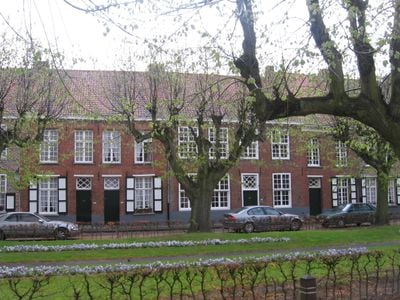
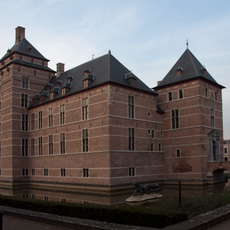
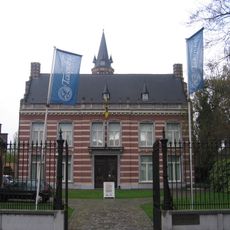
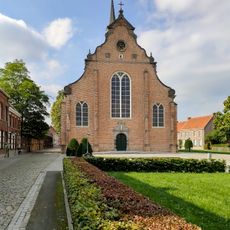
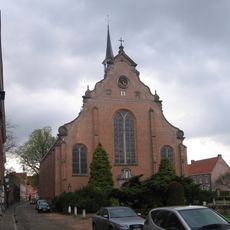
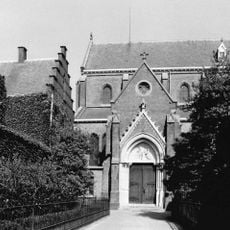
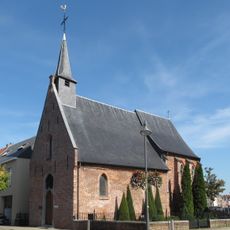
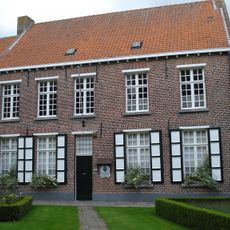
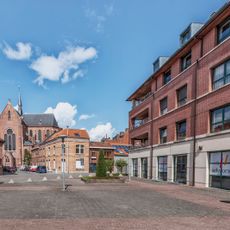
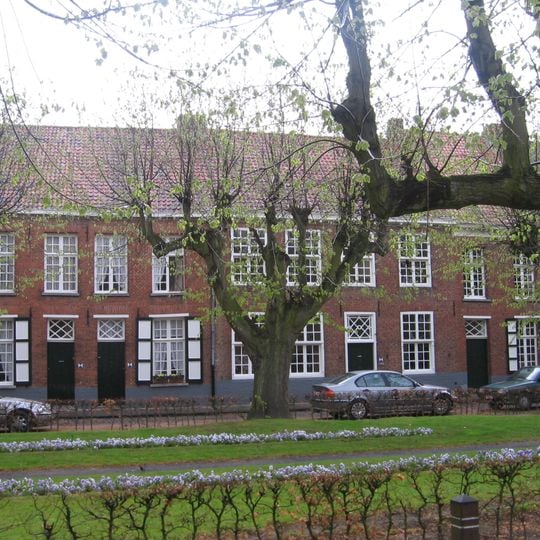
Béguinage Turnhout is a beguinage on the edge of Turnhout's old town, with an elongated central square lined with 16th- and 17th-century houses and a Baroque church. Its early-classicist gatehouse and trapezoidal layout, bounded historically by the Meerloop stream, define the enclosed complex.
Founded probably in the 13th century, the beguinage is first recorded in 1340. Maria of Brabant granted freedoms in 1372, confirmed by her sister Joanna in 1399. A fire damaged it in 1562 and iconoclasts looted the church in 1566. The baroque church was built from 1662 and consecrated in 1666; about 360 beguines lived here in 1693. Under French rule the church became a Temple of Reason in 1797.
From the 17th century the beguinage ran private schools teaching French, needlework and lace-making; four or five were active in the 18th century. The museum, opened on 27 September 1953, covers beguine culture. The last beguine, grand mistress Anna De Boer, died in 2002.
The beguinage lies at the edge of Turnhout's old town, with a long central square of cobblestones and a paved forecourt; the side entrance has a passage. The gardens on the north and west sides slope down towards the vanished Meerloop stream. The museum opened in 1953 and covers the beguine culture.
The beguinage appears in two Samson en Marie music videos: "De Antillen" and "Wij willen voetballen" were filmed among its houses and square. The last beguine, grand mistress Anna De Boer, died in 2002, closing a community documented since 1340.
The community of curious travelers
AroundUs brings together thousands of curated places, local tips, and hidden gems, enriched daily by 94,361 contributors worldwide.