Château of Trois-Fontaines, Medieval castle in Auderghem, Belgium.
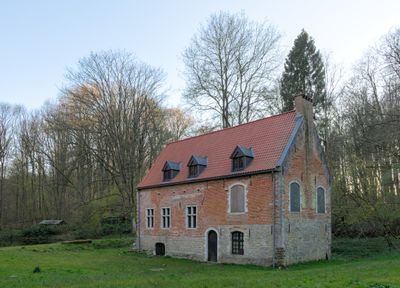
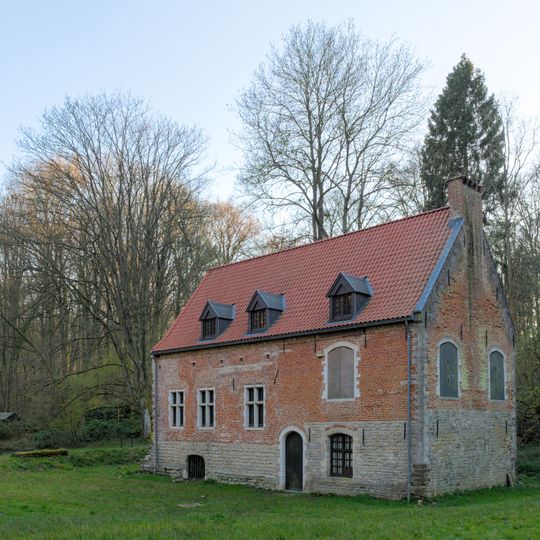
The Château of Trois-Fontaines stands on the Chaussée de Wavre in Auderghem, at the edge of the Sonian Forest. The surviving two-storey building has red brick upper walls over rough grey stone, a steep red-tiled roof with three dormer windows and a brick chimney, and a central arched door reached by steps. Only the foundations of the castle tower remain; inside is a Gothic fireplace and the basement that held the dungeons.
First mentioned in 1329 as Dry Borren, the site was a hunting lodge and prison of the dukes of Brabant; John III founded a chapel there in 1355. Poachers and wood thieves were held from 1373, and the prison was rebuilt under Philip II after the wars of religion. Prisoners were transferred to Laeken in 1786, and the office of forest judge was abolished in 1793.
The name Trois-Fontaines, or Dry Borren in Dutch, refers to the three springs that rose on the site. John III founded a chapel there dedicated to the Virgin Mary and Saint Catherine in 1355, endowing it with 15 old écus, 10 Florentine florins, 12 muids of rye, 50 measures of wood and 25 muids of charcoal, plus grazing rights for four cows or mares in the forest.
The ruins are accessible via Chaussée de Wavre with convenient bus connections nearby. Visitors should prepare for uneven ground and the wooded surroundings.
The name Trois-Fontaines, or Dry Borren in Dutch, comes from the three springs that rose on the site where the hunting lodge was built. The Watermaelbeek stream still flows alongside the grounds. The castle appears as the April scene in the Hunts of Maximilian tapestry series of 1532.
The community of curious travelers
AroundUs brings together thousands of curated places, local tips, and hidden gems, enriched daily by 93,485 contributors worldwide.