Onze-Lieve-Vrouw-Geboortekerk, Roman Catholic church in Oostham, Belgium.
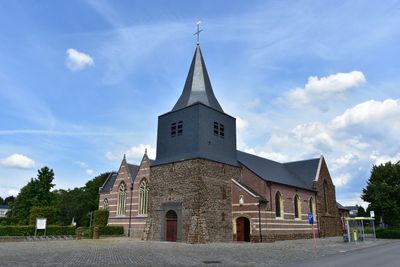
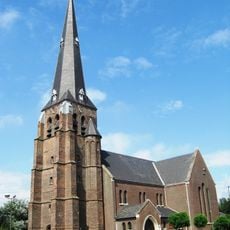
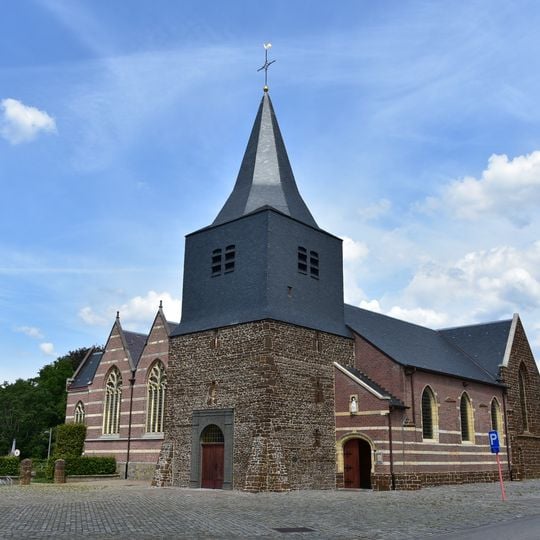
The Onze-Lieve-Vrouw-Geboortekerk is a parish church at the Heldenplein in Oostham, Ham. Its square tower retains a 10th-century base of iron-rich sandstone laid in opus spicatum, topped by a wooden section with a slate-covered, constricted needle spire. The brick nave has sandstone bands, and the neo-Gothic transept is built of iron-rich sandstone.
A first chapel likely stood here in the early 8th century; around 900 a single-aisle church of iron sandstone replaced it, its foundations uncovered in 1940. The lower tower, in opus spicatum, dates from the 10th century. Averbode Abbey, holder of the patronage, added a late-Gothic choir and transepts in the 14th century, two aisles in 1603, and repairs followed in 1749, 1757 and 1758. A fire on 11 May 1940 left only the outer walls and tower, rebuilt 1956-1958 by architect N. van Malleghem.
The church keeps nineteen wooden saint statues, most from the 16th century. At least four — Lucia, Lambertus, Barbara and Catharina — are attributed to the so-called Master of Ham. A 16th-century wooden Christopher and a 15th-century Gothic Man of Sorrows are also kept here.
The main entrance is easily accessible from the village street and provides straightforward access to the interior. For guided tours or inquiries about visiting arrangements, contacting the local municipal office is recommended.
The lower tower is built in opus spicatum, a herringbone pattern of iron-rich sandstone blocks, and is counted among the oldest surviving church towers in Belgium. The upper section is timber clad in slate, with a squat, tapering needle spire. The tower was fully closed until a portal was cut into it in 1836.
The community of curious travelers
AroundUs brings together thousands of curated places, local tips, and hidden gems, enriched daily by 94,863 contributors worldwide.